EN
EN

Carbon Nanotube Dispersion Without Damage: The Complete Guide to Breaking CNT Agglomerates on a Planetary Centrifugal Mixer
CNTs only deliver their conductivity when they are dispersed — and only when their tubes survive the process. Here is how to get both.
How to disperse carbon nanotubes without cutting the tubes: break agglomerates with uniform centrifugal shear, vacuum and speed control on a planetary mixer.
Carbon nanotube dispersion is the process of breaking up entangled CNT agglomerates and distributing individual tubes evenly throughout a base material while keeping the tube structure intact.
Carbon nanotubes are called the king of nanomaterials for good reason: they carry current densities up to a thousand times higher than copper, and they build a three-dimensional conductive network at only one-sixth to one-half of the loading of conventional conductive additives.
That is why CNTs now power lithium battery electrodes, conductive coatings, and electromagnetic shielding compounds — but every application depends on getting the tubes apart without breaking them.
The Core Contradiction of CNT Dispersion
CNTs are born tangled: their high aspect ratio and high surface energy make them cling, wrap, and form dense agglomerates.
Breaking those agglomerates takes enough shear force, but aggressive mechanical treatment snaps tubes as readily as it breaks bundles — shortening the tubes and destroying the very conductive network the material was added to build.
The measurable consequences are shorter tubes, higher resistance, and unpredictable batches.
In short, the dispersion step decides how much of the CNT's theoretical performance actually reaches the final product.
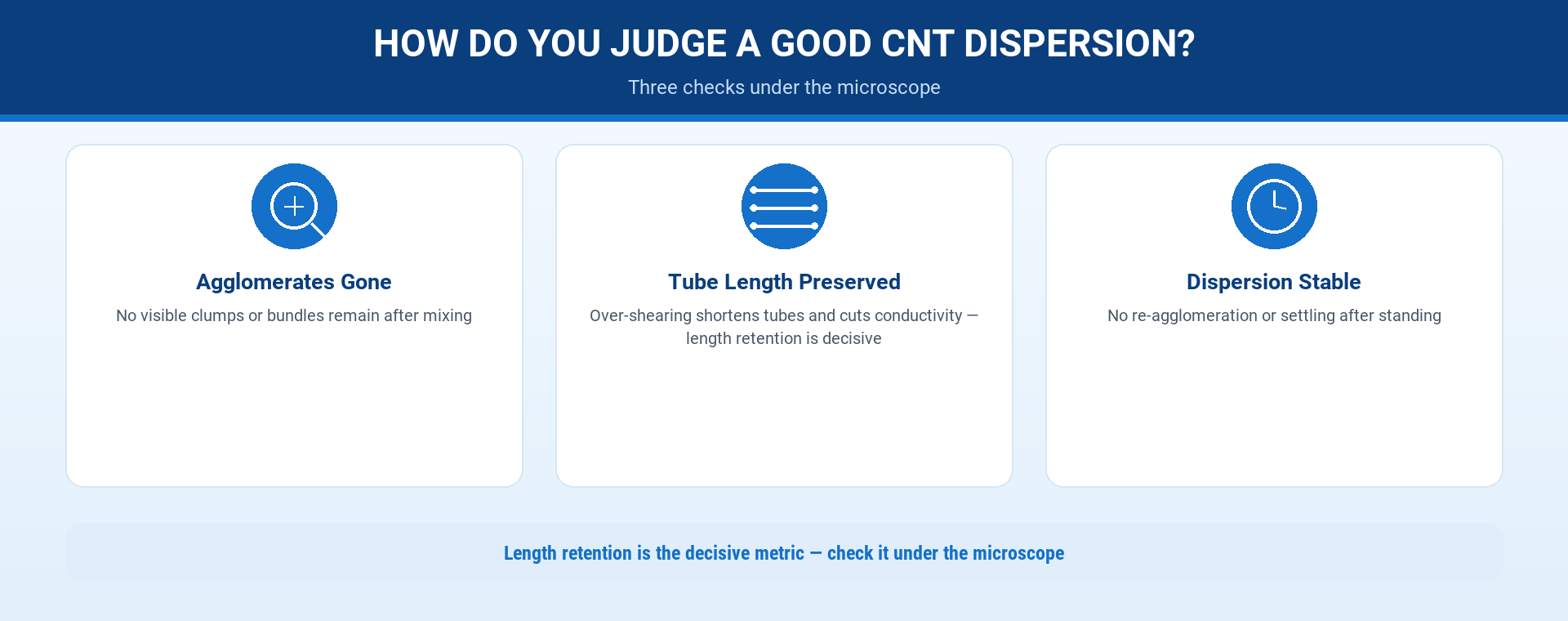
How to Judge a CNT Dispersion: Three Checks
Three checks cover the essentials:
-
Agglomerate breakup.
Visible clumps under the microscope mean the shear field was not strong or even enough. -
Tube length retention.
Measure the length distribution after mixing; severe shortening means the process over-sheared — a common failure of sand mills and high-shear rotor systems. -
Dispersion stability.
Let the batch stand and check again; re-agglomeration and settling mean the dispersion was never truly stabilized.
Make these three checks your acceptance criteria, not an afterthought.
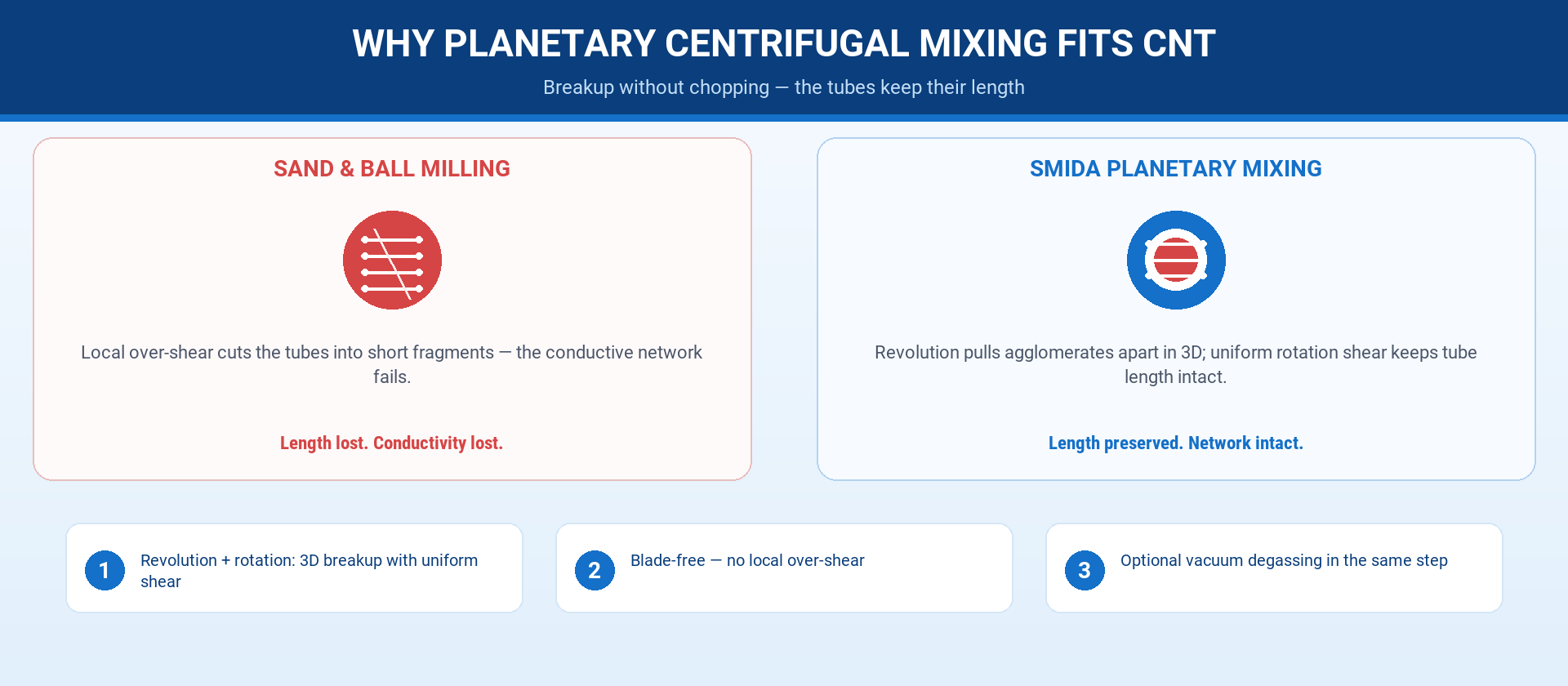
Why a Planetary Centrifugal Mixer Breaks Agglomerates Without Breaking Tubes
The answer lies in the force field a planetary centrifugal mixer creates.
Two motions act at once: revolution, in which the cup carrier orbits the machine's central axis, and rotation, in which each cup spins on its own axis.
Revolution compresses the batch and pulls agglomerates apart in three dimensions; rotation applies uniform shear across the cup — no blade tips, no narrow gaps, no over-shear.
Sand milling and ball milling, by contrast, rely on intense local collisions — exactly what shortens CNT tubes.
A planetary centrifugal mixer separates agglomerates with bulk acceleration instead, preserving tube length while still achieving the dispersion quality a conductive network requires.
The sealed cups add a second benefit: optional vacuum degassing down to 0.2 kPa removes air entrapped during dispersion in the same cycle, so no separate degassing step is needed.
A Practical Process for CNT Users
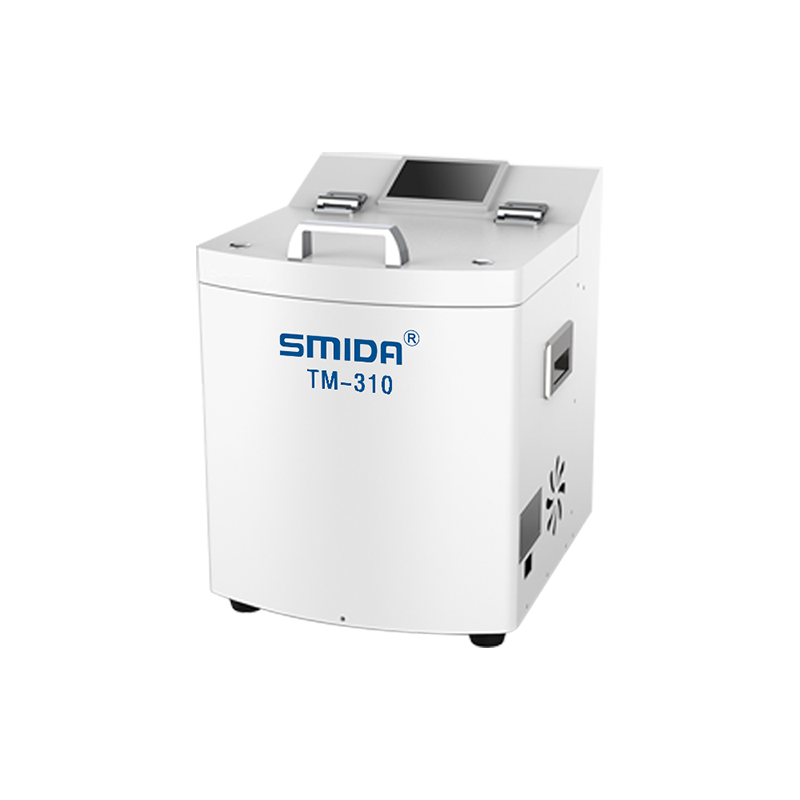
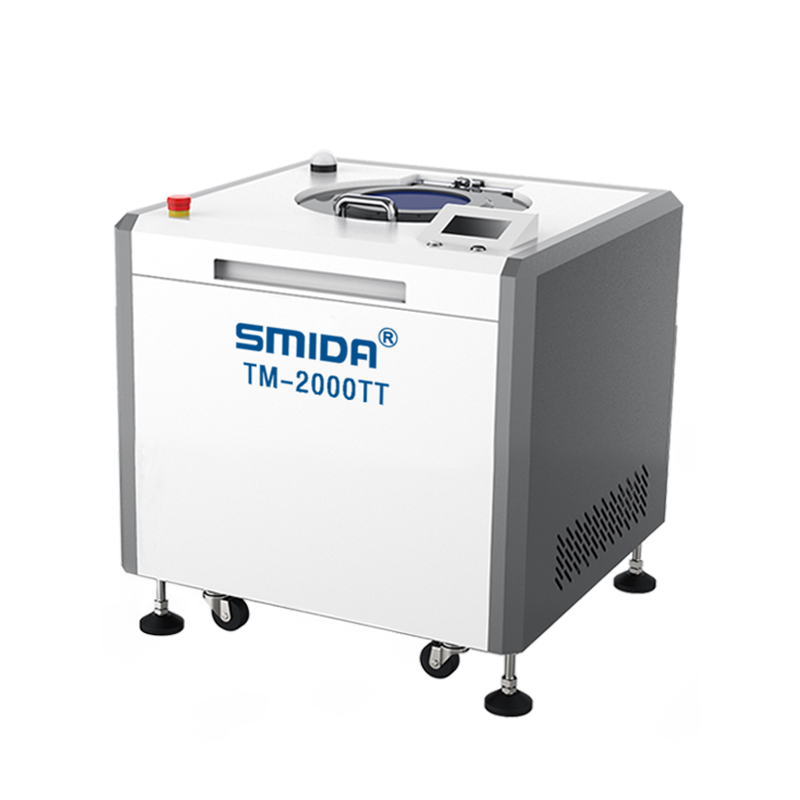
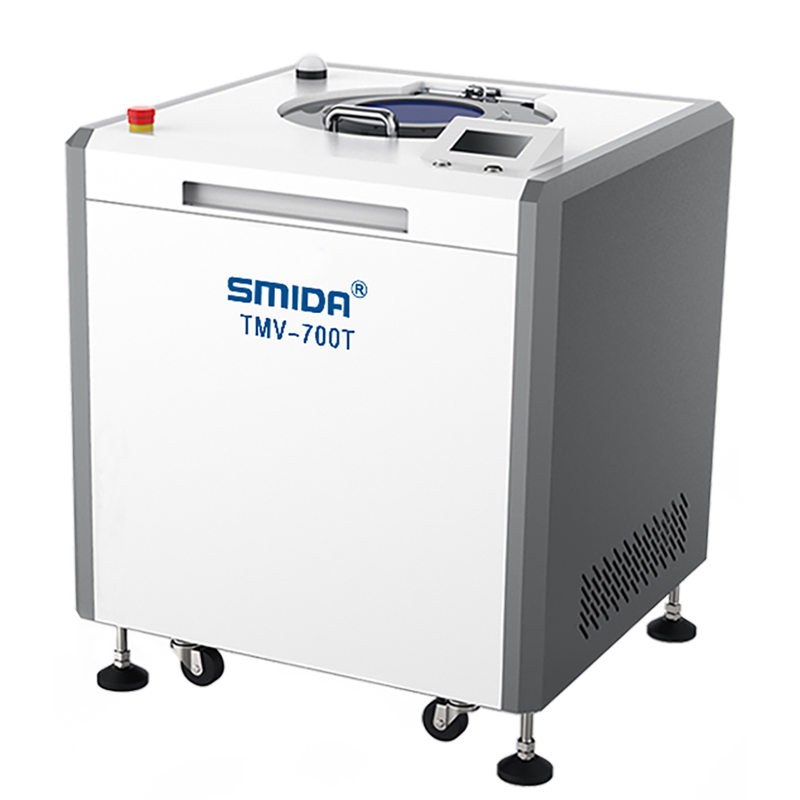
Start at low concentration and low speed to find your dispersion window, then ramp up while checking tube length at each level — SMIDA's independent speed control, from 200 to 2000 rpm, shapes the shear field precisely.
After dispersing, measure tube length distribution and stability, then fix those parameters as your standard operating procedure.
When scaling to production, choose a larger machine with the same mixing principle and control logic, so the force field — and the results — travel with you.
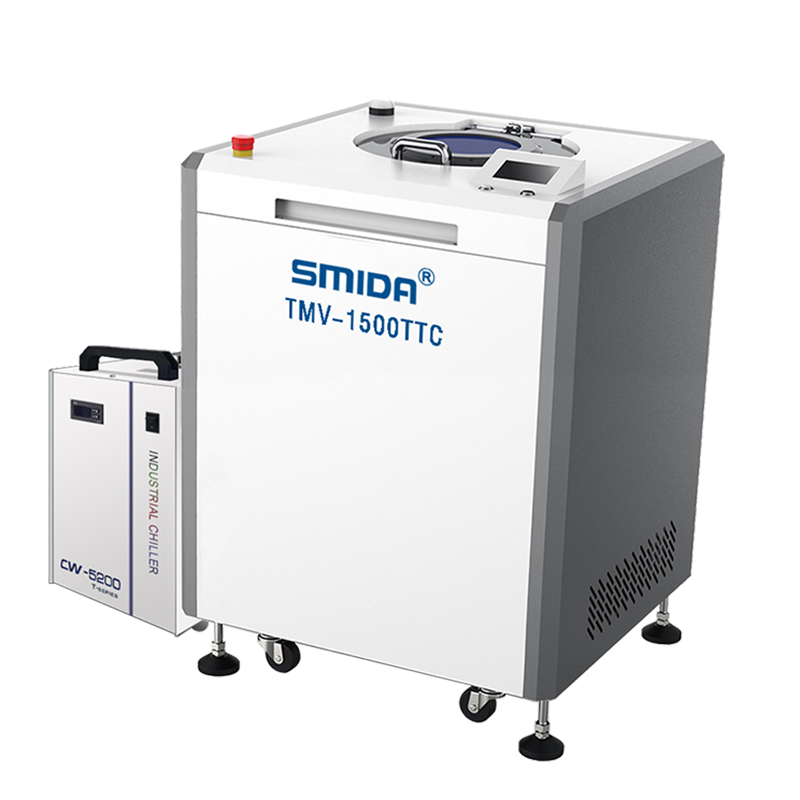
For heat-sensitive systems, SMIDA's TTC models hold the batch at -15 °C to 25 °C so the dispersion window does not drift while you mix.
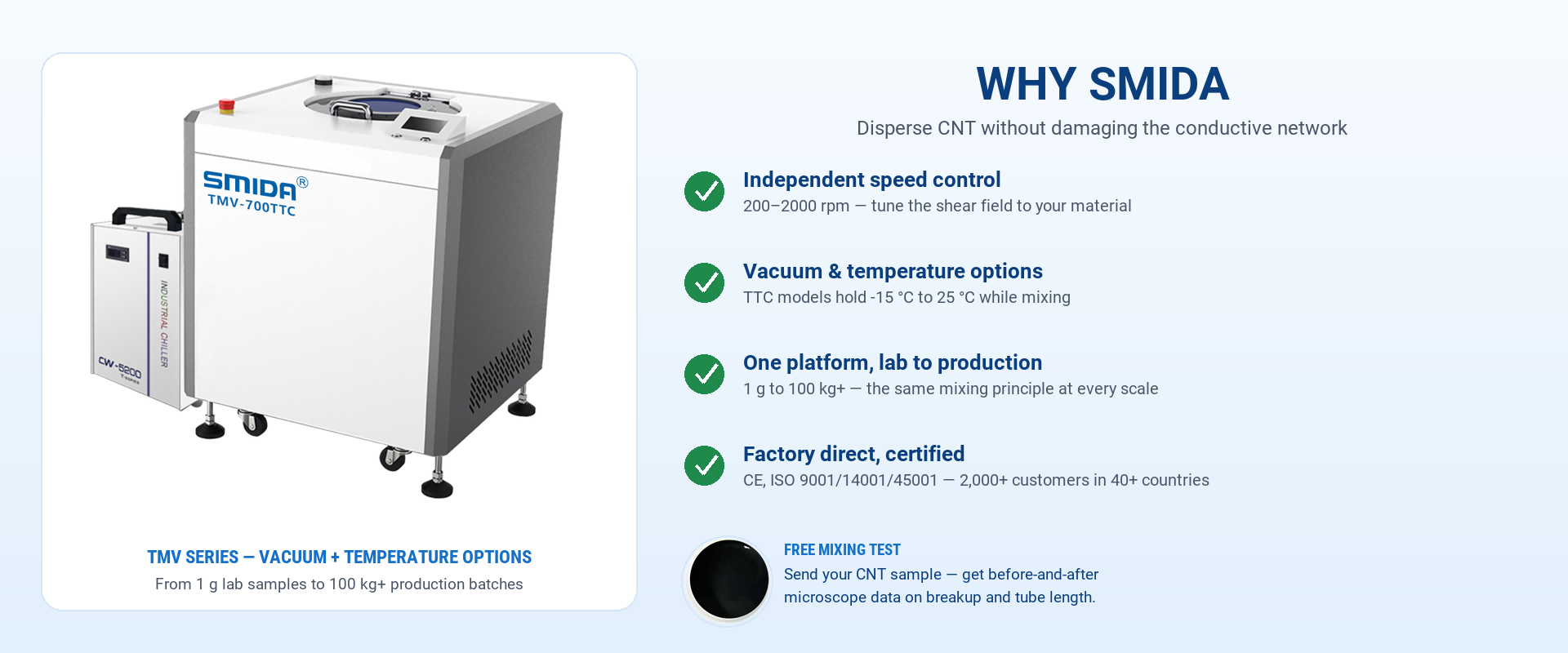
Why SMIDA for CNT Dispersion
-
One platform, lab to production.
Mixing volume from 1 g to 100 kg+, with equipment from 150 g bench units to 100 kg+ production machines — the same principle at every scale. -
Blade-free by design.
Material touches only the cup, so there is no metal debris, no cross-contamination, and no blade cleaning between batches. -
Process flexibility.
Independent revolution and rotation speed control, optional vacuum to 0.2 kPa, and temperature control from -15 °C to 25 °C on TTC models. -
Factory-direct trust.
SMIDA is a Shenzhen manufacturer with 17+ years in material processing, CE, ISO 9001, ISO 14001 and ISO 45001 certified, serving 2,000+ customers in 40+ countries.
Frequently Asked Questions
Will a planetary centrifugal mixer cut or shorten my CNT tubes?
No — the process is blade-free and the shear is uniform across the whole batch.
There are no high-shear tips or grinding media, so agglomerates break apart while tube length is preserved.
What is the best speed for dispersing carbon nanotubes?
There is no universal number — it depends on your CNT type, loading, and base material.
Start low and ramp up gradually while checking tube length at each step; SMIDA's control from 200 to 2000 rpm is designed for exactly this tuning.
Can the mixer also remove bubbles from a CNT slurry?
Yes.
Vacuum models evacuate the chamber to 0.2 kPa, so air entrapped during dispersion is removed in the same mixing cycle.
Will the same parameters work when I scale up?
Yes — every SMIDA machine shares the same planetary centrifugal mixing principle and control logic, so parameters developed on a lab unit transfer to production machines of the same family with minimal re-tuning.
Cross-capacity comparison data can be generated during your sample test.
The Bottom Line
Carbon nanotubes are only as good as their dispersion: break the agglomerates and keep the tubes — that discipline decides whether your battery slurry, coating, or shielding compound delivers the conductivity it was designed for.
Test it on your own material: send a CNT sample to the SMIDA lab for a free mixing test.
You will get before-and-after microscope data on agglomerate breakup and tube length retention, plus a clear model recommendation — from 1 g lab samples to 100 kg+ machines — before you spend a dollar.

 Hot News