EN
EN

Vacuum Defoaming for High-Viscosity Slurries: How a Planetary Centrifugal Mixer Removes Bubbles in Minutes
Trapped air is costing you bond strength, conductivity and surface quality — here is how vacuum centrifugal mixing removes it in minutes, not days.
A vacuum defoaming mixer removes trapped air from high-viscosity adhesives, conductive pastes and coatings in minutes, with centrifugal force and 0.2 kPa vacuum.
If you have ever mixed an adhesive, a conductive paste, or a coating by hand — or even with a conventional stirrer — you know the drill: scrape, stir, wait, scrape again, and still end up with tiny bubbles you cannot get rid of.
Air bubbles are the silent enemy of every formulator.
Left alone, they form stress points that weaken bond lines, block electrical pathways in conductive inks, and leave pinholes that ruin surface finish.
The frustrating part is that they are so hard to remove from thick materials.
In a high-viscosity slurry, a microbubble can take days to rise to the surface on its own — because the bubble must first travel to the liquid surface, form a film, rupture, and finally escape.
The thicker the material, the slower that entire sequence becomes.
What Is a Vacuum Defoaming Mixer?
A vacuum defoaming mixer (often called a vacuum degassing mixer or debubbling machine) is a mixer that combines centrifugal mixing with a vacuum chamber.
Materials are placed in sealed cups that spin at high speed inside an evacuated chamber.
The spinning motion generates strong centrifugal force, while the vacuum simultaneously pulls air out of the material.
The two effects work together: the centrifugal force compresses the batch and drives trapped bubbles toward the surface, and the vacuum removes them before they can reform.
A planetary centrifugal mixer is a specific type of vacuum defoaming mixer in which the cups both revolve around a central axis (revolution) and rotate on their own axis (rotation).
This dual motion produces a powerful, three-dimensional flow field that mixes and degasses in one step — no blades, no paddles, no dead zones.
The Real Cost of Trapped Air
Bubbles are not just an aesthetic nuisance.
They show up in measurable ways:
-
Weakened adhesive bonds.
Air pockets act as stress concentrators.
Under thermal cycling or mechanical load, bonds fail earlier and more suddenly. -
Lost electrical performance.
In silver paste and other conductive slurries, bubbles block current paths, raise sheet resistance, and hurt print definition and adhesion. -
Inconsistent appearance.
Coatings, gels, and encapsulants with entrapped air come out cloudy or dimpled, and batch-to-batch viscosity and clarity drift unpredictably.
Waiting for bubbles to disappear naturally is rarely an option in production.
Heating helps, but it can damage heat-sensitive ingredients.
Mechanical stirring only forces more air in.
That is why more and more formulators are moving their degassing step onto a dedicated vacuum defoaming mixer.
How Vacuum Defoaming Works Inside the Machine
The working principle of a planetary vacuum mixer comes down to three forces:
-
Revolution (orbit).
The cup carrier spins around the machine's central axis at high speed.
Centrifugal force pushes material outward and downward, compacting the batch and squeezing bubbles toward the surface. -
Rotation (spin).
Each cup also rotates on its own axis, creating shear at the cup wall.
This breaks up agglomerates while the batch keeps moving, so nothing sits still long enough to stratify. -
Vacuum.
The chamber is evacuated to a deep vacuum — SMIDA's TMV series reaches 0.2 kPa — so bubbles expand and burst at the surface instead of staying suspended.
Because the cups are sealed, the process also prevents moisture pickup and solvent loss, which matters for moisture-sensitive systems.
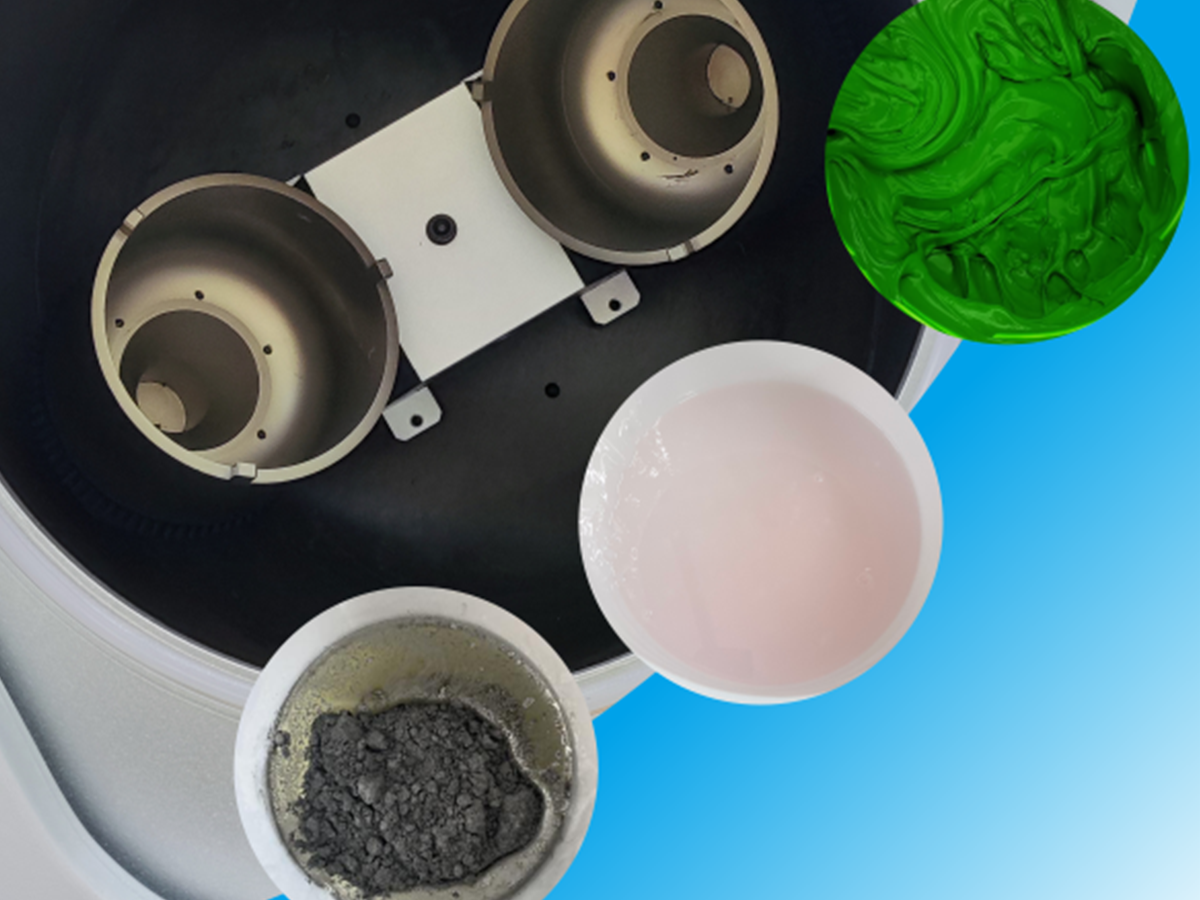
The before-and-after photos above show a high-viscosity adhesive processed on a SMIDA vacuum mixer: the hazy, bubble-laden paste on the left becomes a clear, uniform material on the right after a few minutes under vacuum.
Is Your Material a Good Fit for Centrifugal Degassing?
Three quick checks will tell you whether a vacuum planetary mixer belongs in your process:
-
Viscosity.
Centrifugal degassing handles everything from low-viscosity inks to pastes up to about 2,000,000 cP — the range where settling and bubble entrapment are worst. -
Shear sensitivity.
Because mixing happens without blades, delicate fillers and long-chain polymers are not chopped or damaged. -
Closed-system requirements.
If you need to prevent solvent evaporation, moisture absorption, or oxygen exposure, the sealed-cup design is a clear advantage.
Materials that check all three boxes — conductive pastes, adhesives, potting compounds, cosmetic creams, battery slurries — are exactly the ones that benefit most from a vacuum defoaming mixer.
Choosing the Right Machine: What to Compare
When you evaluate vacuum defoaming mixers, look past the headline speed and compare the parameters that actually determine results:
| Parameter | Why It Matters | SMIDA TMV Series |
|---|---|---|
| Vacuum level | Deeper vacuum removes smaller, more stubborn bubbles | 0.2 kPa |
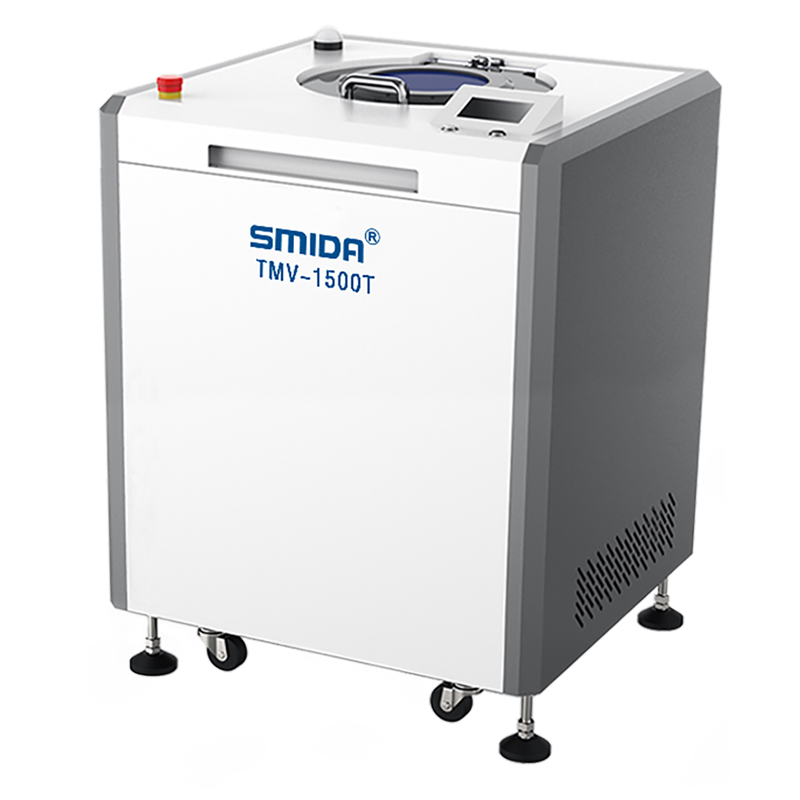
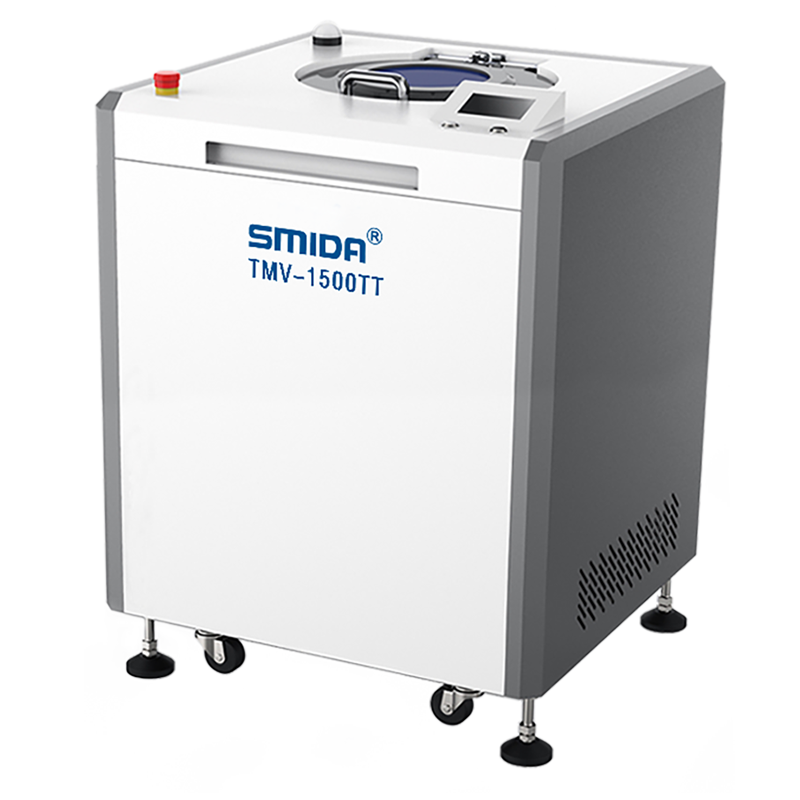
| Capacity range | One platform should cover R&D and production | 150 g to 100 kg+ |
| Speed control | Independent revolution/rotation control shapes the flow field | 200–2000 rpm |
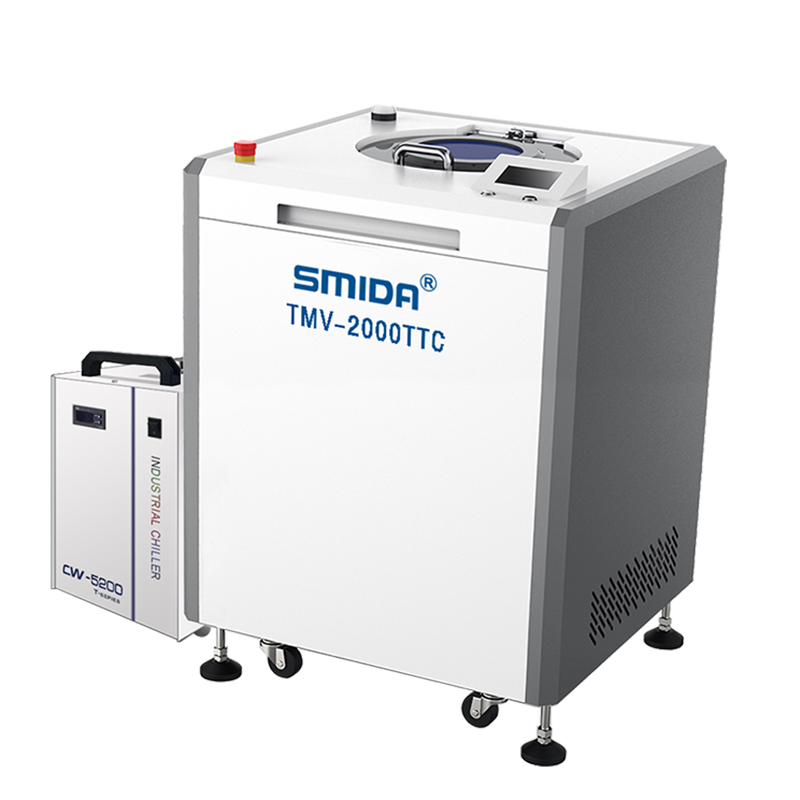
| Temperature control | Prevents heat-sensitive materials from degrading during mixing | -15 °C to 25 °C (TTC models) |
| Certifications | CE, ISO 9001, ISO 14001, ISO 45001, ISO 14001 and ISO 45001 confirm safety and quality systems | CE, ISO 9001, ISO 14001, ISO 45001 |
Frequently Asked Questions
How long does vacuum defoaming take?
For most high-viscosity slurries, a few minutes of mixing under 0.2 kPa vacuum is enough to remove visible and microbubbles — compared with hours or days of settling, or repeated passes through a vacuum chamber.
Can a vacuum defoaming mixer replace a vacuum chamber?
For high-viscosity materials, yes — usually more effectively.
A vacuum chamber relies on bubbles rising passively, which is extremely slow in thick pastes.
A planetary centrifugal mixer actively drives bubbles out with centrifugal force while the vacuum removes them, in a fraction of the time.
Does the mixer damage shear-sensitive materials?
No blades touch the material, so shear is applied gently and evenly.
Fillers such as silver flakes, glass frit, and ceramic powders keep their shape and size distribution.
Do I need a vacuum model, or is a standard mixer enough?
If bubbles directly affect your product's performance — conductive pastes, encapsulants, thermal gels — choose the vacuum model.
For materials without bubble concerns, the non-vacuum model is faster and more economical.
The Bottom Line
Degassing should not be the slowest step on your line.
A vacuum planetary centrifugal mixer collapses hours of settling into minutes of processing, and it does so without the contamination, dead zones, or heat build-up of blade-based mixers.
If a particular slurry has been fighting you on bubbles, send a sample to the SMIDA lab.
We will run your material on our own machines, show you the before-and-after results, and recommend the right model — from 1 g lab samples to 100 kg+ production machines — before you spend a dollar.
 Hot News