EN
EN

From Lab Bench to Production Floor: Scaling Up Planetary Centrifugal Mixing Without Losing Your Recipe
Scaling up mixing is not about a bigger machine — it is about keeping the force field, flow pattern and vacuum constant from lab to line.
Learn how a production-scale planetary centrifugal mixer platform keeps force fields constant from 150 g to 100 kg+, so lab recipes scale without re-tuning.
"Works in the lab, fails on the line."
Every materials engineer has heard it, and most have lived it.
The mixing dynamics of a small machine and a production machine are rarely the same: shear distribution shifts, flow patterns change, and the carefully tuned parameters from the bench stop meaning anything on the floor.
The gap between R&D and production stretches project timelines and burns budget on trial and error.
Why Scale-Up Fails
Scaling up a mixing process is not about buying a bigger machine.
It is about keeping three things constant:
-
The centrifugal force field per unit of material.
Dispersion quality in centrifugal mixing is driven by centrifugal acceleration.
When you scale up, the speed-to-capacity relationship must be maintained so the material experiences the same forces. -
The mixing trajectory and flow pattern.
The ratio of revolution speed to rotation speed determines how material flows inside the cup.
That ratio must stay the same from the lab machine to the production machine, or the mix geometry changes completely. -
The vacuum and temperature conditions.
Degassing efficiency tracks vacuum level; heat build-up tracks cooling capacity.
Before scaling, you must confirm the larger machine reaches the same vacuum level and temperature control.
Miss any one of the three, and your formula changes behavior even though the recipe is identical.
What a Scalable Mixer Platform Looks Like
The practical answer is a product family built on one mixing principle with one control philosophy.
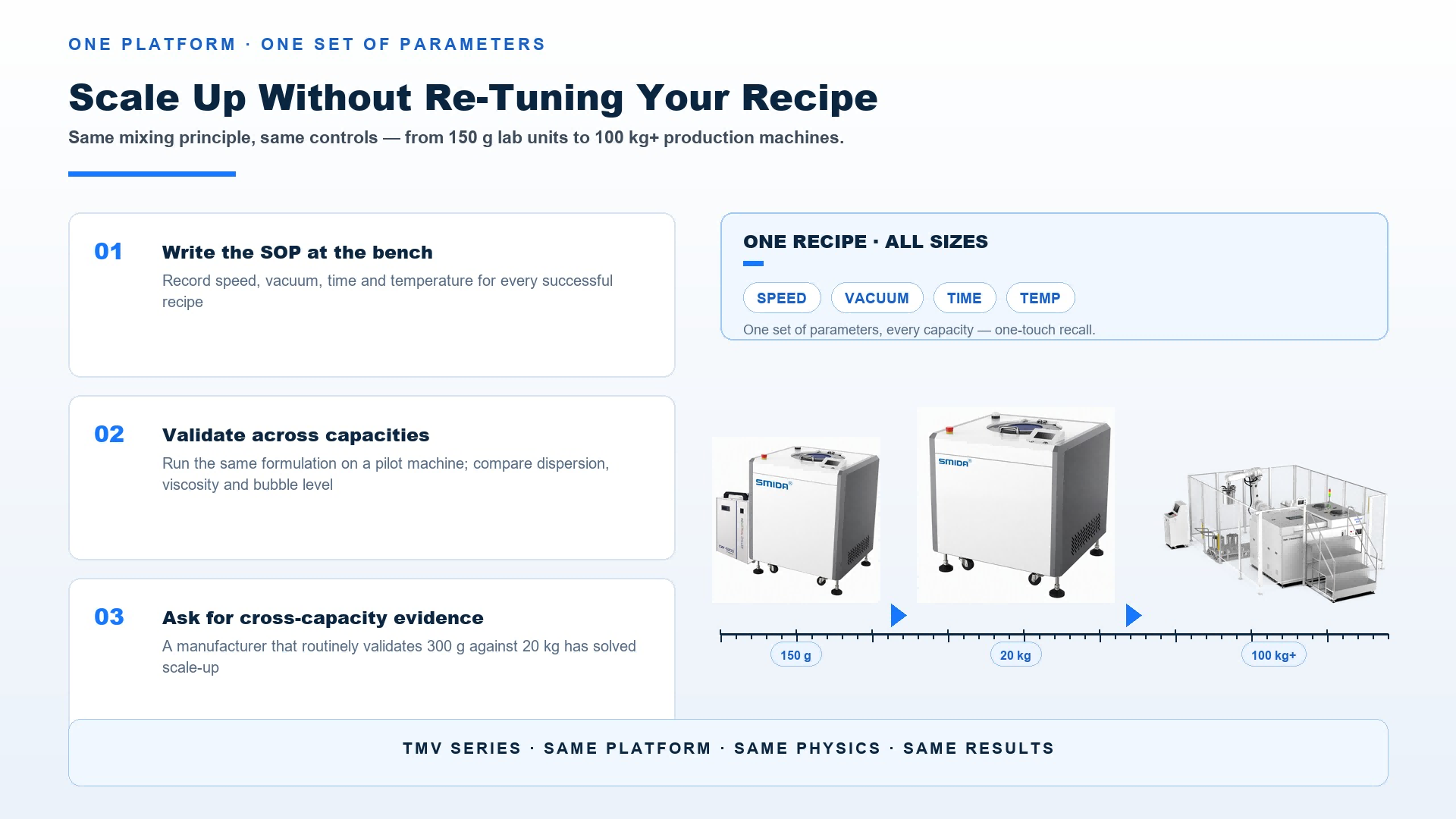
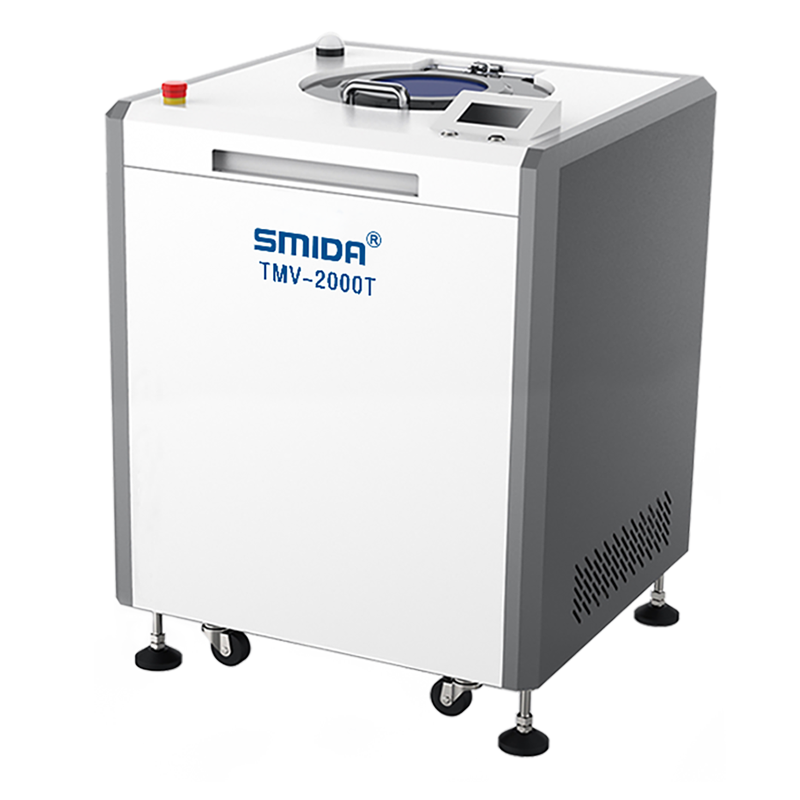
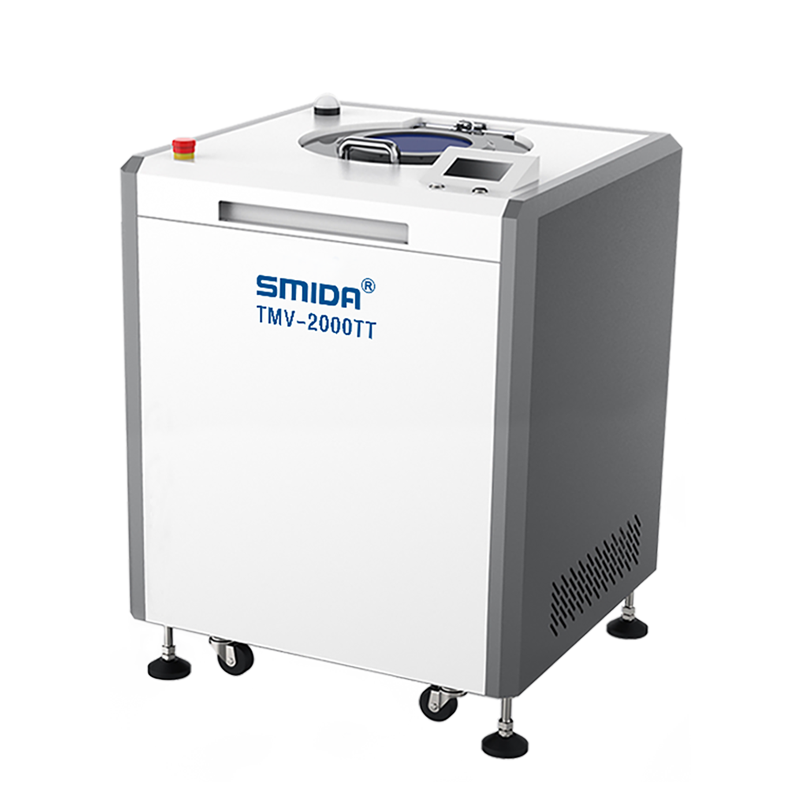
SMIDA's TMV series spans 150 g benchtop models to 100 kg+ industrial machines, mixing as little as 1 g per batch, all sharing:
- the same planetary centrifugal mixing principle — revolution plus rotation, blade-free;
- the same independent control of revolution and rotation speed;
- the same vacuum system design and parameter storage/call-up logic.
That means a recipe locked in on the TMV-310TTC in the lab can be reproduced on the TMV-15000TT on the floor without re-engineering the process.
R&D finalizes the formula; production runs it.
No second round of process development.
Three Habits That Make Scale-Up Predictable
Habit 1 — Write the SOP at the bench.
From day one, record every parameter that matters: revolution speed, rotation speed, vacuum level, mixing time, cup type, and final temperature.
A recipe is not a recipe until it is a standard operating procedure.
Habit 2 — Validate across capacities before committing.
When you move to pilot or production scale, choose a machine from the same platform and run the same formulation through it.
Compare dispersion quality, viscosity, and bubble level against the lab batch.
If they match, you have de-risked the scale-up before spending money on a full production run.
Habit 3 — Ask suppliers for cross-capacity evidence.
A manufacturer that routinely validates the same material on 300 g and 20 kg machines has solved the scale-up problem many times over.
Ask for those case studies — they tell you more than any spec sheet.
Frequently Asked Questions
What is the difference between a benchtop and an industrial planetary centrifugal mixer?
Capacity and duty cycle.
Benchtop models (150 g–2 kg) suit R&D and small-batch trials; industrial models (up to 100 kg+) run continuous production.
When both share the same mixing principle and controls, recipes transfer directly.
Can I use the same recipe parameters on different machine sizes?
On a single-platform family like SMIDA's TMV series, yes — the same revolution/rotation ratio, vacuum level, and time produce equivalent results because the force field is designed to scale.
How do I avoid batch-to-batch inconsistency after scaling up?
Use the machine's parameter storage and one-touch recall to eliminate operator variance, and check viscosity, particle size, and bubble content against your lab reference batch on a fixed schedule.
Is a production-scale planetary centrifugal mixer available as an OEM configuration?
Yes.
SMIDA customizes capacity, vacuum system, temperature control, cup fixtures, and software to your process.
Tell us your batch weight and cycle time and we will size the machine.
The Bottom Line
The highest-return investment in materials R&D is not a better formula — it is making sure the formula survives contact with production.
A mixer platform that scales from 1 g to 100 kg+ with the same physics and the same controls turns scale-up from a gamble into a checklist.
Want to validate scale-up before you commit?
Send us your material; we will run it on both a lab machine and a production machine in our Shenzhen facility and share the cross-capacity comparison with you.


 Hot News