 EN
EN

SMIDA Planetary Centrifugal Mixer: The Ultimate Solution to Three Core Problems of Delamination, Bubbles and Oxidation in Conductive Silver Paste Mixing
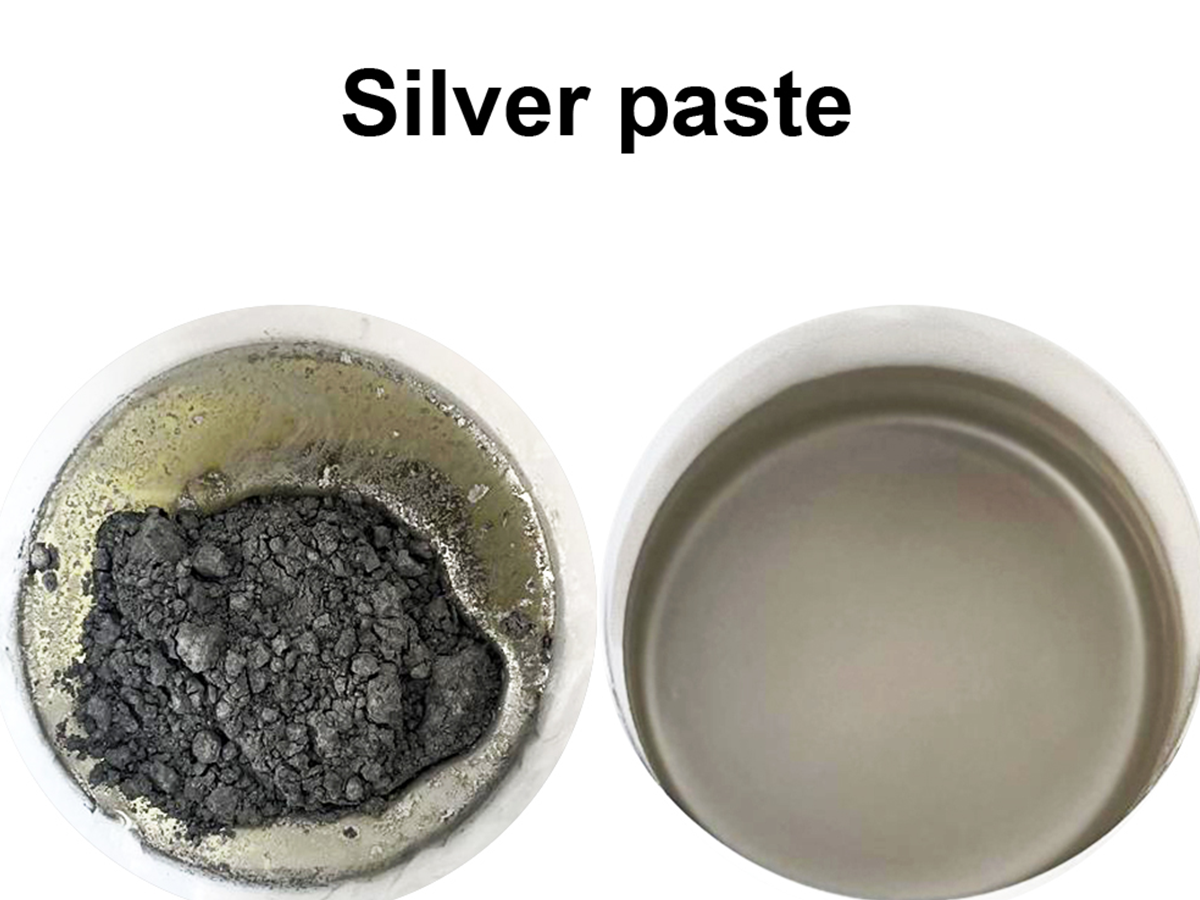
In the precision manufacturing fields of PV conductive silver paste, electronic packaging silver paste and special conductive pastes, the mixing quality of silver paste directly determines the conductivity, adhesion and stability of end products. As a multiphase complex system composed of high-density silver powder + low-density organic vehicle, conductive silver paste mixing has long been plagued by three core pain points: particle delamination and sedimentation, mixing dead zones in high-viscosity systems, and bubble residue with oxidation. Traditional mixing equipment struggles to achieve a mixing effect that balances efficiency and precision. Relying on the synergistic technology system of "Revolution + Rotation + Vacuum + Inert Gas Protection", the SMIDA Planetary Centrifugal Mixer specifically addresses these industry pain points and becomes the core equipment for high-quality mixing of conductive silver paste.
I. Three Core Process Challenges in Conductive Silver Paste Mixing
Particle Delamination and Agglomeration
With a density of up to 10.5g/cm³, silver powder is much higher than that of organic vehicles (resins and solvents with a density of 1-1.2g/cm³). Delamination of "heavy materials sinking to the bottom and light materials floating up" is prone to occur during mixing due to density differences. Meanwhile, silver powder with micron to nano-scale particle size has high surface tension and is extremely easy to agglomerate into secondary particles, leading to discontinuous conductive pathways and directly affecting the consistency of silver paste conductivity.
Mixing Dead Zones in High-Viscosity Systems
The viscosity of high solid content (60%-90%) conductive silver paste can reach more than 50000 mPa·s. Traditional paddle stirring is difficult to drive the overall flow of materials, and "stagnant zones" are easily formed on the tank wall and bottom, resulting in local formula deviation. Problems such as uneven conductivity and reduced adhesion are prone to occur in subsequent printing and sintering processes.
Bubble Residue and Oxidation Risk
High-speed stirring easily entrains air to form micron-scale bubbles. If not completely removed, pores will form after sintering, reducing the compactness and conductivity of silver paste. At the same time, silver powder is prone to oxidation to form silver oxide (Ag₂O) when exposed to air for a long time, leading to a decrease in sintering activity and a final conductivity attenuation of 10%-30%.
II. SMIDA Customized Mixing Solution: Three Technological Breakthroughs to Solve the Pain Points
1. 3D Composite Force Field: Realize Global Homogeneous Dispersion of Silver Powder and Eliminate Delamination & Agglomeration
SMIDA adopts a composite force field design of "Revolution + Rotation + 45° Inclined Axis", with a revolution speed of 100-2500rpm and an independently adjustable rotation speed at a 0-2 ratio to revolution, forming a triple effect of centrifugal diffusion + boundary shear + axial tumbling. The strong centrifugal force generated by revolution (centrifugal acceleration up to several times the gravitational acceleration) pushes the silver powder to move toward the tank wall to avoid sedimentation; the shear force formed by rotation "tears" agglomerated particles; the 45° inclined axis makes the materials present spatial spiral motion, completely eliminating mixing dead zones. Ultimately, the silver powder is uniformly dispersed in the organic vehicle, with a mixing uniformity of over 99.5%, the silver powder agglomeration rate reduced to below 0.3%, and the continuity of conductive pathways improved by 30%.
2. Vacuum Protection: Thorough Defoaming + Anti-Oxidation to Ensure Silver Paste Purity
High-Vacuum Defoaming System
The vacuum planetary centrifugal mixer is standard equipped with a high-vacuum system, which extracts bubbles synchronously during the mixing process — the centrifugal force of revolution squeezes internal bubbles to the surface to form an "enriched layer". Under the vacuum environment, the bubbles expand and rupture rapidly and are removed, with a defoaming rate of 99.9%, completely avoiding pore defects.
Optional Inert Gas Protection Function
An optional nitrogen/argon protection system isolates air and moisture throughout the mixing process, controlling the silver powder oxidation rate below 0.1%. It effectively maintains the chemical purity and high surface activity of silver powder, ensuring stable conductivity after sintering.
3. High-Torque Drive + Precise Temperature Control: Adapt to High Viscosity and Ensure Formula Stability
The mixer is equipped with a high-torque, low-speed drive mechanism, which can start smoothly and continuously stir ultra-high viscosity silver paste with a viscosity of more than 50000 mPa·s, avoiding the problem of "weak stirring and material stagnation" of traditional equipment.
4. Post-Process Compatibility: Optimize Pre-Treatment State and Improve Overall Production Efficiency
The silver paste mixed by SMIDA features uniform components, sufficient wetting and consistent fluidity, providing an ideal premix for subsequent three-roll mill precision grinding, with the feeding uniformity improved by 40%. It effectively reduces the energy consumption and time cost of the grinding process, forms a complete efficient mixing-grinding process chain, and ensures the reliability and reproducibility of the final dispersion effect.
Summary
In conductive silver paste production, the SMIDA Planetary Centrifugal Mixer has gone beyond the scope of a simple mixing device and become a core process link for controlling product quality from the source. By solving the three fundamental problems of "uniformity, bubbles and oxidation", it provides an initial guarantee for the high performance, high consistency and high reliability of silver paste in PV, electronic packaging and other fields, and helps enterprises improve production yield and market competitiveness.