EN
EN

Why Lab Recipes Fail on the Production Line: The Scale-Up Consistency Guide
The formula that works in the lab rarely survives contact with a different machine — unless the mixing principle and the parameters travel with it.
Why lab recipes fail on the production line: force fields, flow patterns and parameters change with equipment. Learn same-principle scale-up with SMIDA mixers.
Process scale-up is the science of transferring a formula from laboratory equipment to production equipment while keeping the result — dispersion quality, uniformity, and batch consistency — identical.
It is the most widely quoted curse in the materials industry: the lab batch is perfect, but on a production machine the dispersion is different and the batches drift.
More often than not, the recipe is not the problem — the equipment is.
The Three Root Causes of Scale-Up Failure
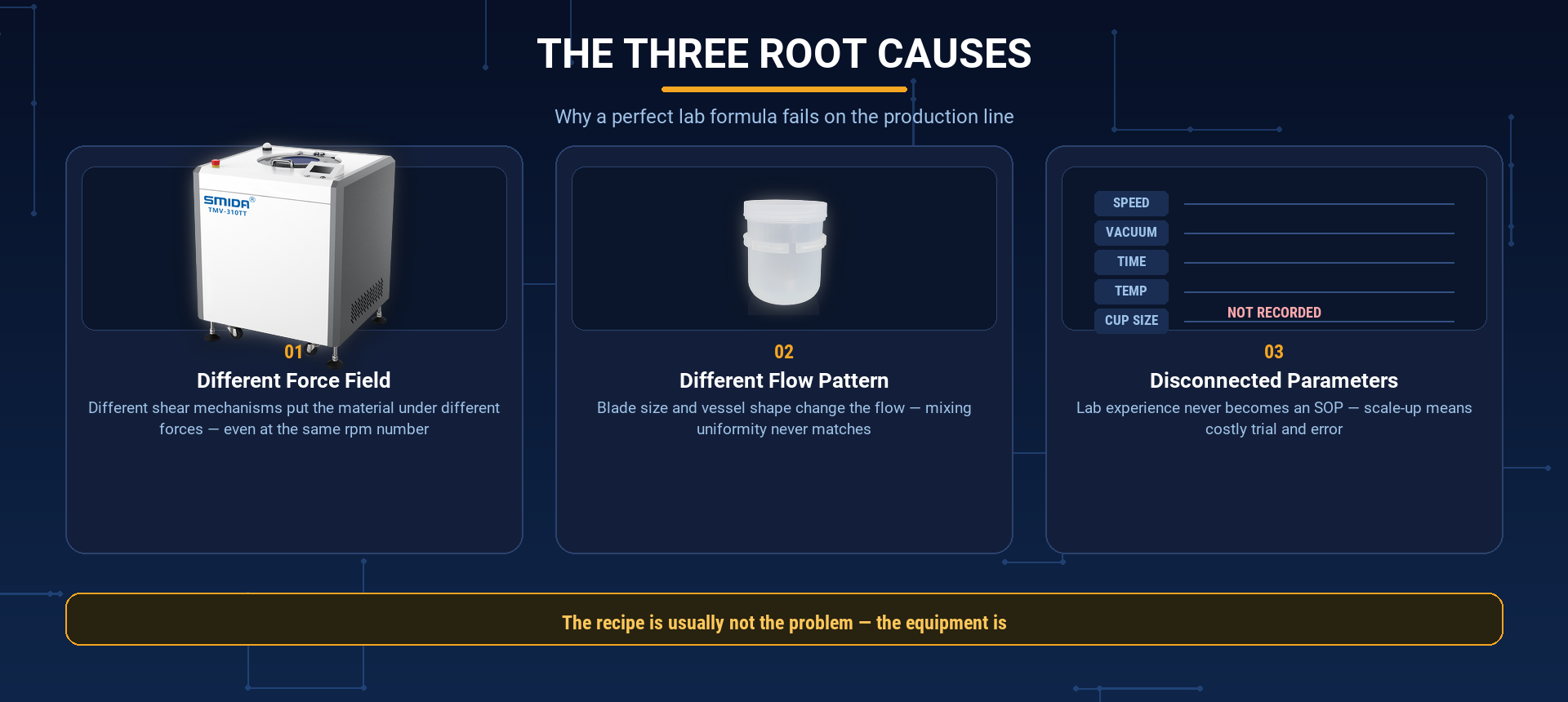
Every failed scale-up can be traced to one of three gaps:
-
Different force field.
The shear mechanism of a lab device and a production line is rarely the same: identical rpm numbers can mean completely different stress states — your formula was tuned for a force field that production never applies. -
Different flow pattern.
Blade size, vessel shape, and geometry all change with capacity.
Material moves through the machine along a completely different path, so the mixing uniformity you measured in the lab simply does not reproduce. -
Disconnected parameters.
Lab "experience parameters" never become a standard operating procedure, so at scale-up time the engineer re-tunes the process from memory — and every round of trial and error costs materials, machine time, and schedule.
These three gaps compound.
Even a formula that was robust in the lab fails on the line when the equipment changes everything except the recipe card.
What Is Same-Principle Scale-Up?
Same-principle scale-up is a strategy in which laboratory and production machines are chosen to share the same mixing mechanism, so that the force field acting on the material is identical at every scale.
Instead of changing the physics and re-tuning the recipe, you keep the physics constant and change only the cup size.
This is where planetary centrifugal mixing shows its strength: from a bench unit to a 100 kg+ production machine, the centrifugal force field logic is the same — only the cup gets bigger.
How to Raise Your Scale-Up Success Rate
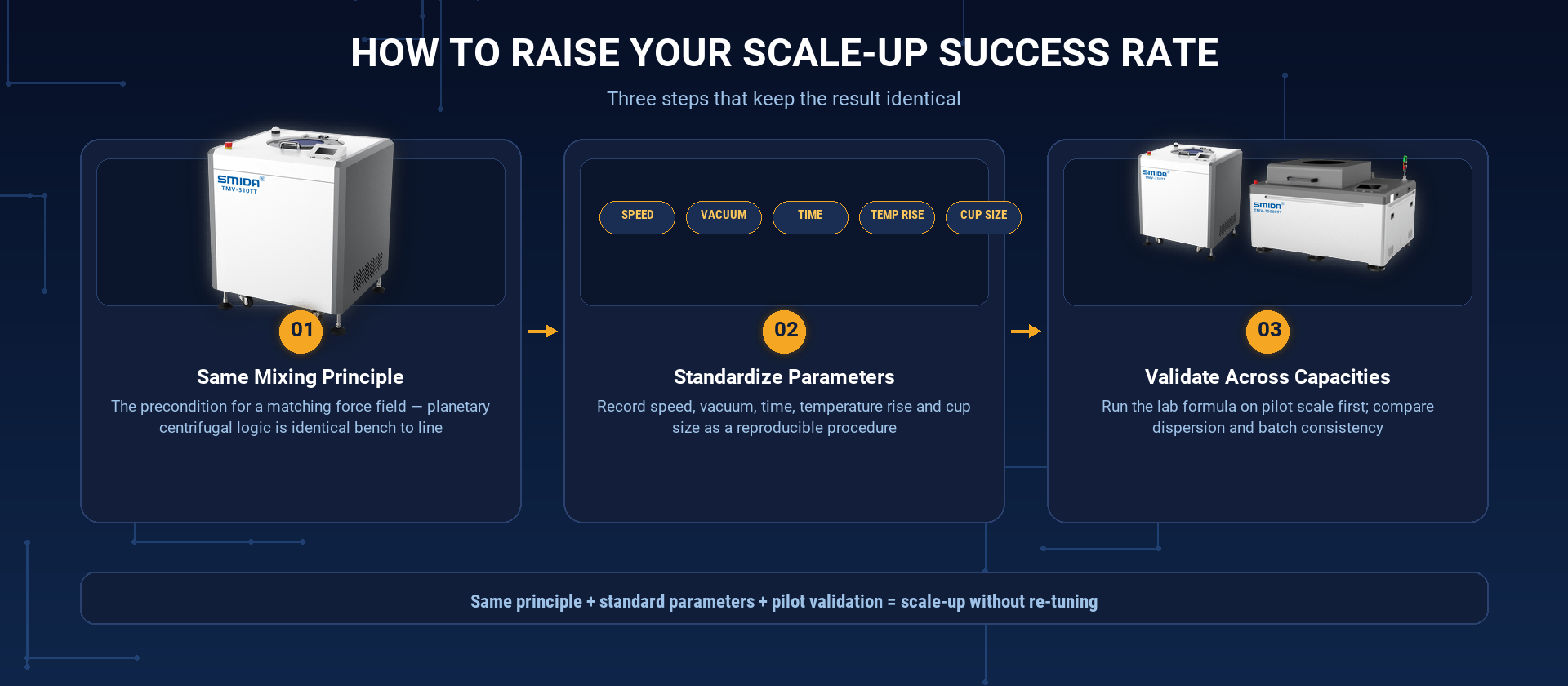
Three steps turn scale-up from a gamble into a procedure:
-
Choose the same principle first.
Select lab and production equipment from the same mixing principle before you develop the formula, not after.
With planetary centrifugal mixing, the force field logic is constant from 1 g lab samples to 100 kg+ batches, so the formula behaves the same way everywhere. -
Standardize every parameter.
For each successful formula, record speed, vacuum level, time, temperature rise, and cup specification.
Speed control from 200 to 2000 rpm and vacuum down to 0.2 kPa are numbers worth logging — they become the reproducible standard operating procedure for the line. -
Validate across capacities.
Before full production, run the lab formula on a pilot-capacity machine and compare dispersion quality and batch consistency against the lab result.
If the pilot matches, production will follow.
This sequence costs a few days of validation and saves months of production rework.
How SMIDA Makes Scale-Up Predictable
SMIDA builds scale-up consistency into the platform itself.
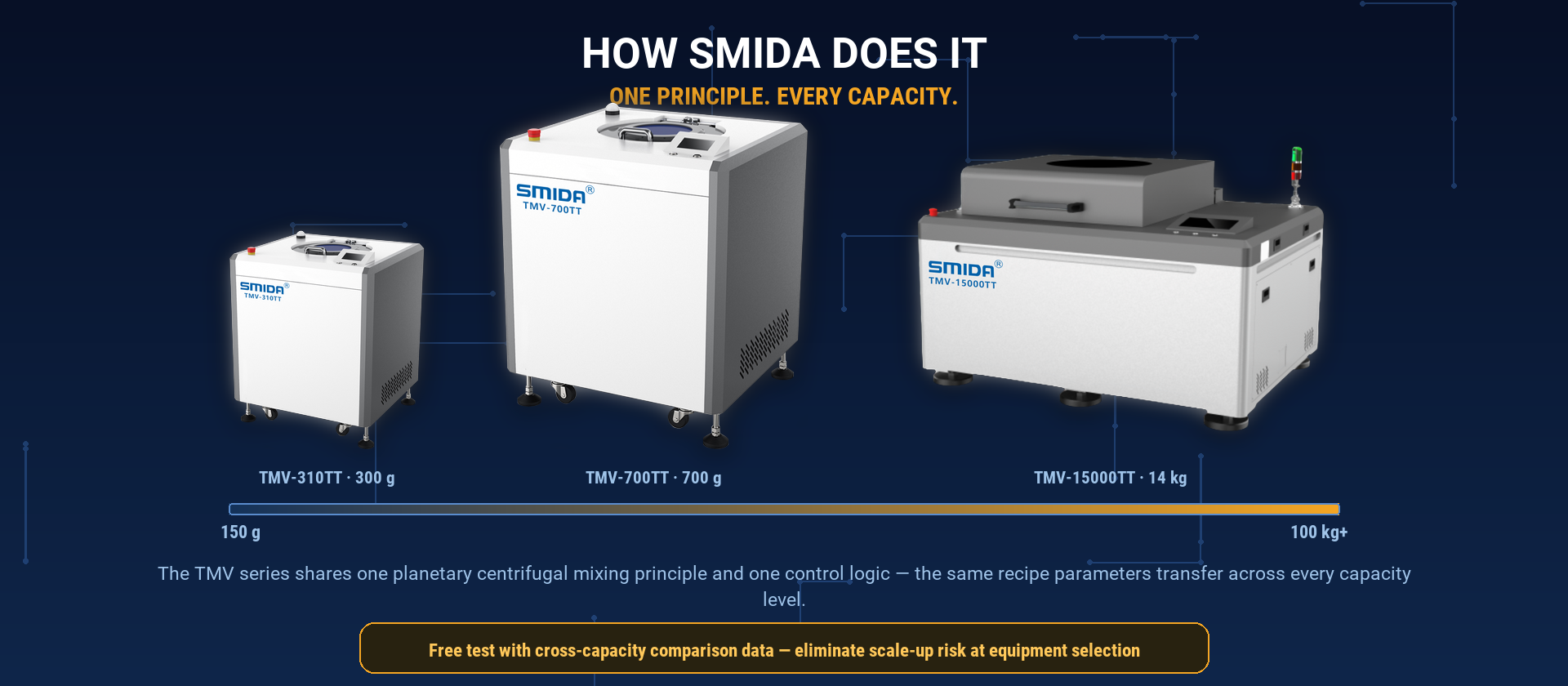
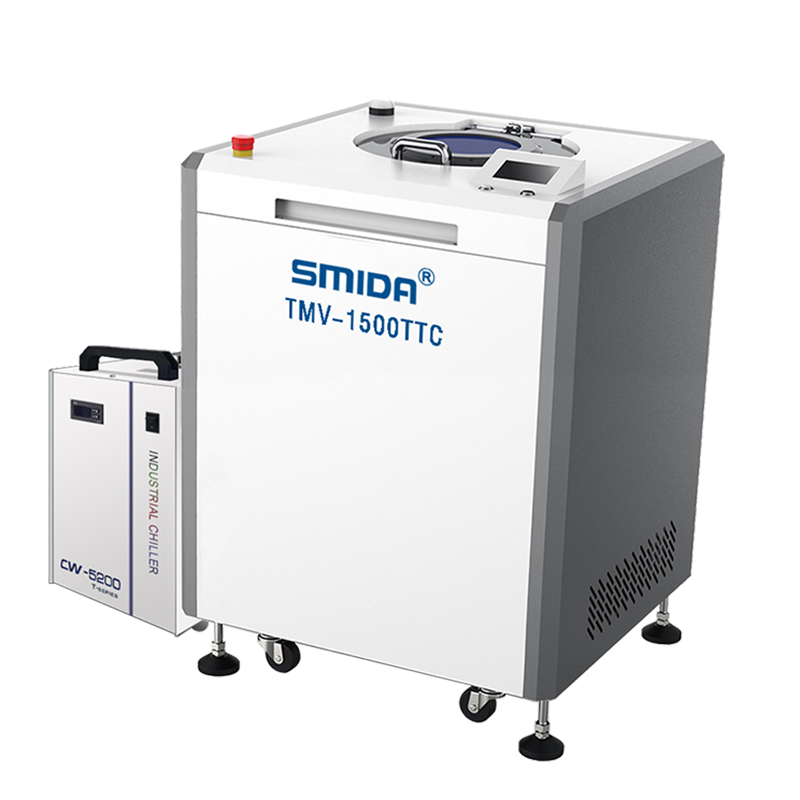
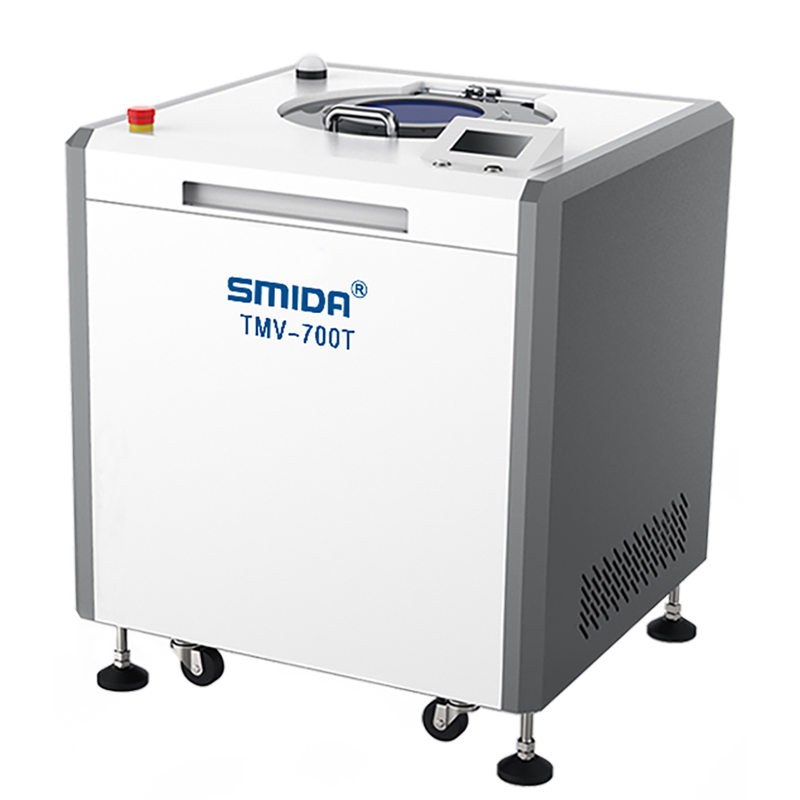
The TMV series — from 150 g bench units to 100 kg+ production machines — shares a single planetary centrifugal mixing principle and a single control system.
Recipe parameters developed on a lab unit transfer to larger capacities with minimal re-tuning, because the physics underneath does not change.
Additional control points make the transfer even safer:
- Independent revolution and rotation speed control from 200 to 2000 rpm, so the shear field is tuned and locked;
- Vacuum to 0.2 kPa, keeping the degassing result consistent from lab to line;
- Temperature-controlled TTC models from -15 °C to 25 °C, so heat-sensitive formulas do not behave differently when the batch gets bigger;
- Dual-cup design and sealed cups, giving you parallel samples in the lab and consistent, contamination-free batches in production;
- Cross-capacity comparison data with every sample test, so scale-up risk is eliminated at the equipment selection stage.
Behind the machines: SMIDA is a Shenzhen manufacturer with 17+ years in material processing, CE, ISO 9001, ISO 14001 and ISO 45001 certified, trusted by 2,000+ customers in 40+ countries.
Frequently Asked Questions
Why do my lab batches and production batches look different?
Because the force field, flow pattern, and parameter chain change with the machine.
Different shear mechanisms put the same recipe under different stress — the formula is fine, the physics changed.
Can I scale up without changing my formula?
Yes — if you keep the mixing principle the same.
With planetary centrifugal mixing, the force field logic is identical from 1 g to 100 kg+, so the formula transfers with minimal re-tuning.
What parameters should I record for scale-up?
Speed (200 to 2000 rpm), vacuum level (down to 0.2 kPa), mixing time, temperature rise, and cup specification.
These become the standard operating procedure that makes the recipe reproducible at any capacity.
Does SMIDA provide cross-capacity validation?
Yes.
During a sample test, SMIDA can generate cross-capacity comparison data, showing you how dispersion and batch consistency hold from lab to pilot to production scale.
The Bottom Line
The biggest waste in R&D is not a failed experiment.
It is a successful lab formula that cannot be mass-produced.
Make scale-up consistency your first equipment criterion — that single decision protects years of development from the moment it leaves the lab.
Send a sample to the SMIDA lab for a free mixing test with cross-capacity comparison data, and see your formula survive the move to production.

 Hot News