EN
EN

Silver Paste Mixing & Degassing: The Complete Guide to Bubble-Free Conductive Pastes
The quality of silver paste is decided at the mixing stage — before printing, before sintering, before anything else.
Silver paste mixing degassing machine guide: why flakes settle, why bubbles ruin conductivity, and how to keep paste uniform and bubble-free.
Silver paste sits at the heart of photovoltaics, LED packaging, semiconductor die-attach, and printed sensors.
It has to conduct current reliably, print cleanly, and sinter into a dense, low-resistance film.
Getting there depends far more on how the paste is mixed than most process engineers expect.
Why Silver Paste Is So Difficult to Mix
Silver paste is a three-phase system — metal flakes, glass frit, and an organic vehicle — and every phase fights the others during mixing:
-
Settling and stratification.
Silver flakes are dense and fine; the organic vehicle is light.
Left to their own devices, the two separate quickly, which is why pastes settle in storage and why poor mixing leaves a thin, silver-starved layer at the top of the batch. -
High viscosity with no flow.
High-solid, solvent-free formulations are extremely thick.
Conventional stirring moves material near the blade but leaves stagnant zones at the wall and in corners, so part of the batch never actually mixes. -
Entrained air.
Fast stirring sucks air in.
Microbubbles that survive into printing cause voids, poor print definition, and weak adhesion after sintering. -
Oxidation risk.
Silver powder exposed to air for extended periods develops surface oxide, which suppresses sintering activity and raises final resistivity.
The Three-Stage Silver Paste Process
A robust silver paste line follows the same skeleton whether you are making photovoltaic front-side paste or LED die-attach paste:
Stage 1 — Premixing.
Weigh silver powder, glass frit, and organic vehicle; premix at low speed to wet the powder and break up dry agglomerates before any fine processing begins.
Stage 2 — Mixing and degassing.
This is the stage that decides paste quality.
The material must be homogenized and degassed at the same time, ideally in a closed or inert atmosphere to protect the silver from oxidation.
Stage 3 — Grinding and printing.
A fully degassed paste flows consistently, prints with crisp edges and no voids, and sinters into a denser film with lower sheet resistance.
Why a Planetary Centrifugal Mixer Is the Right Tool for Silver Paste
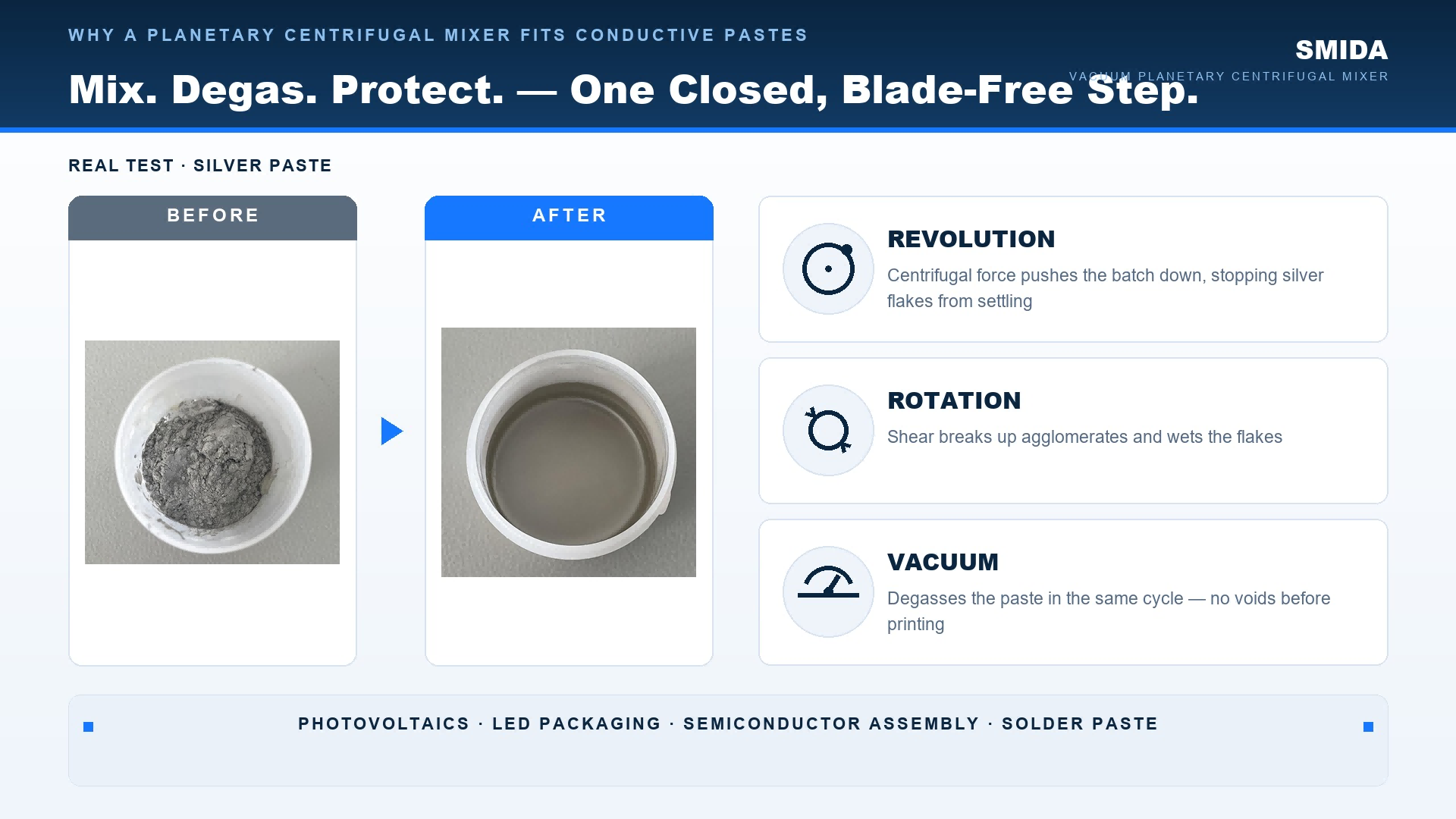
A planetary centrifugal mixer attacks every problem above simultaneously.
The cups revolve around the machine axis and spin on their own axis, generating a combined force field:
- Centrifugal force from revolution pushes material from the center to the cup wall, preventing silver flakes from settling out.
- Shear from rotation at the cup wall breaks up agglomerates and wets the flake surfaces.
- Vacuum degassing (optional) pulls microbubbles out during mixing, so paste comes out bubble-free in one step instead of two.
The whole process is blade-free.
Nothing touches the material except the cup, which matters enormously for a high-value, high-purity material like silver paste: no blade wear, no metal debris, no cross-contamination between batches.
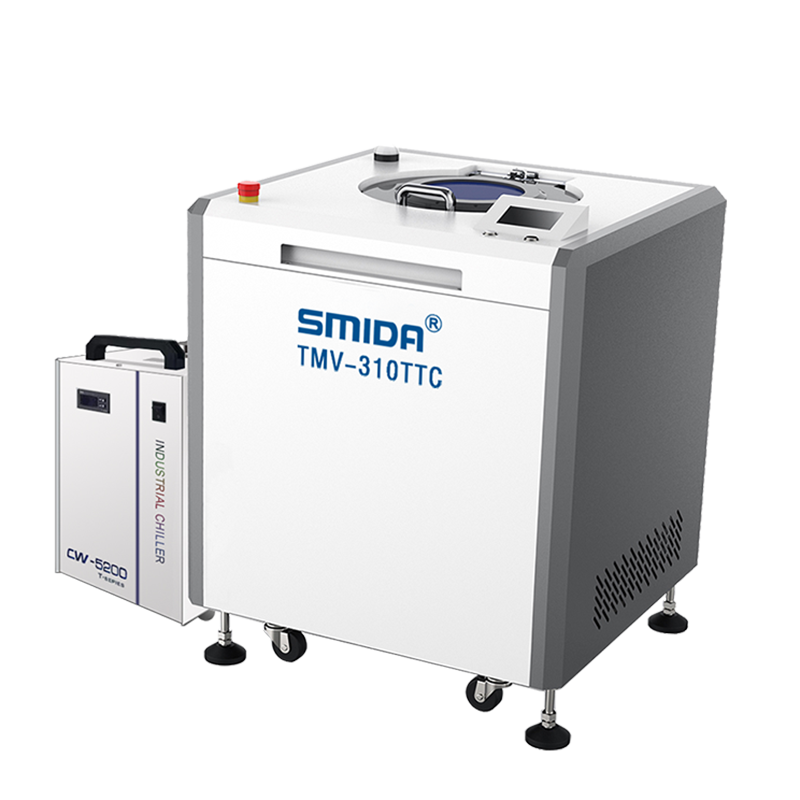
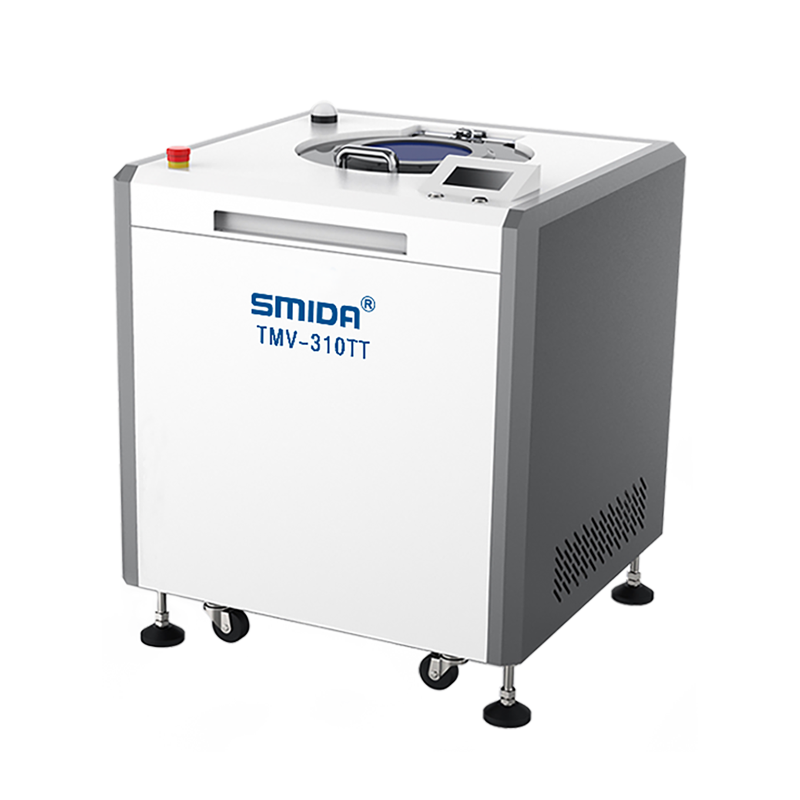
The dual-cup design on models like the TMV-310TT also lets you process two formulations at once — a real time-saver when you are iterating on paste recipes in R&D.
Practical Advice for Paste Formulators
Start small.
Validate your recipe on a 100–300 g lab machine — the TMV-310 series is built for exactly this — and lock in the revolution speed, rotation speed, vacuum level, and mixing time for each formulation.
Only then scale up to a larger machine for pilot and production.
Because the entire SMIDA family (mixing 1 g to 100 kg+, equipment 150 g to 100 kg+) shares the same planetary centrifugal mixing principle and control logic, the parameters you freeze in the lab transfer directly to production machines.
You avoid the industry's most expensive cliché: a formula that works at the bench and fails on the floor.
Frequently Asked Questions
Can a planetary centrifugal mixer really degas silver paste?
Yes.
With the vacuum option, the mixer pulls the chamber down to 0.2 kPa while centrifugal force drives bubbles to the surface — most paste batches are fully degassed in minutes.
Will mixing damage silver flakes?
Blade-free centrifugal mixing applies shear gently and evenly, so flake morphology and size distribution are preserved.
That is critical: damaged flakes raise resistivity and hurt sintering density.
Do I need an inert atmosphere?
SMIDA vacuum models can be operated with the cups sealed, which limits air exposure.
For highly oxidation-sensitive pastes, discuss inert-gas options with our engineers — we can tailor the configuration.
What capacity do I need?
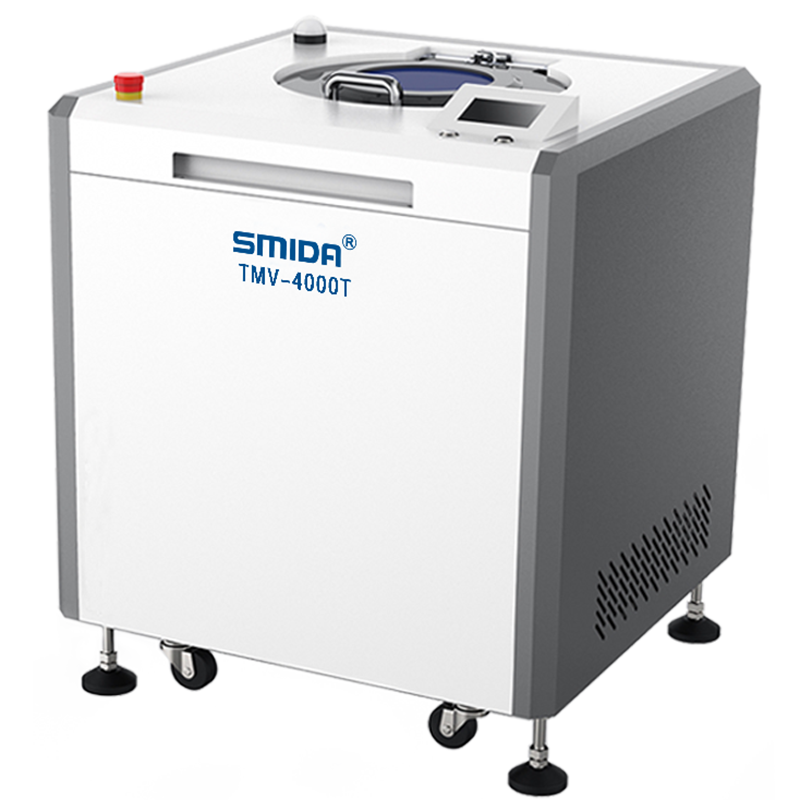
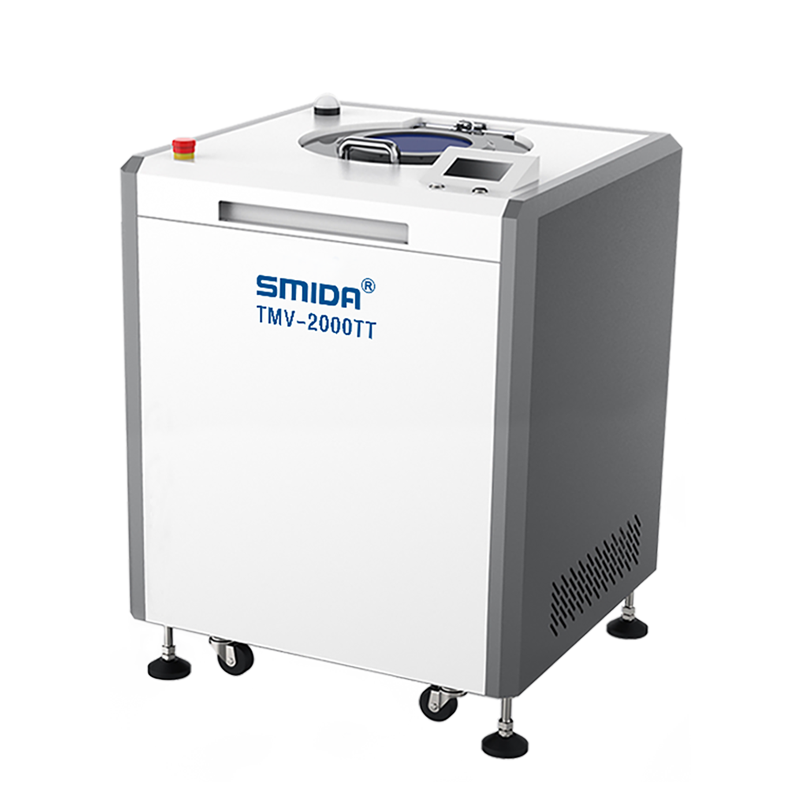
Match capacity to batch size: 150–310 g for R&D, 700 g to 4 kg for pilot, and up to 100 kg+ for production runs.
We will help you size the machine from your target batch weight and cycle time.
The Bottom Line
Silver paste quality is decided early, at the mixing stage.
A conductive paste planetary mixer that homogenizes, degasses, and protects the silver in one closed, blade-free step gives your printing and sintering processes the consistent feedstock they need.
Send a sample of your paste to the SMIDA lab.
We will run it through our mixing and degassing process, return before-and-after data, and recommend the right model and parameters for your recipe — free of charge.
 Hot News