EN
EN

Cosmetic Cream Blade-Free Mixing and Degassing: A Complete Guide
Powdery grit and trapped air are the two most common texture killers in cosmetic creams — here is how blade-free centrifugal mixing and vacuum degassing eliminate both.
A complete guide to blade-free cosmetic cream mixing and degassing: how centrifugal force and 0.2 kPa vacuum remove powdery grit and bubbles from lab to production.
The moment a consumer touches a cream, the purchase decision is already half made.
"Melts on contact", "silky smooth", "glides without residue" — these promises live or die in the mixing cup.
Skincare and makeup creams are the most texture-driven products on the shelf, yet many brands only discover their mixing problem after a batch fails the sensory panel.
What Is a Blade-Free Cream Mixing and Degassing Machine?
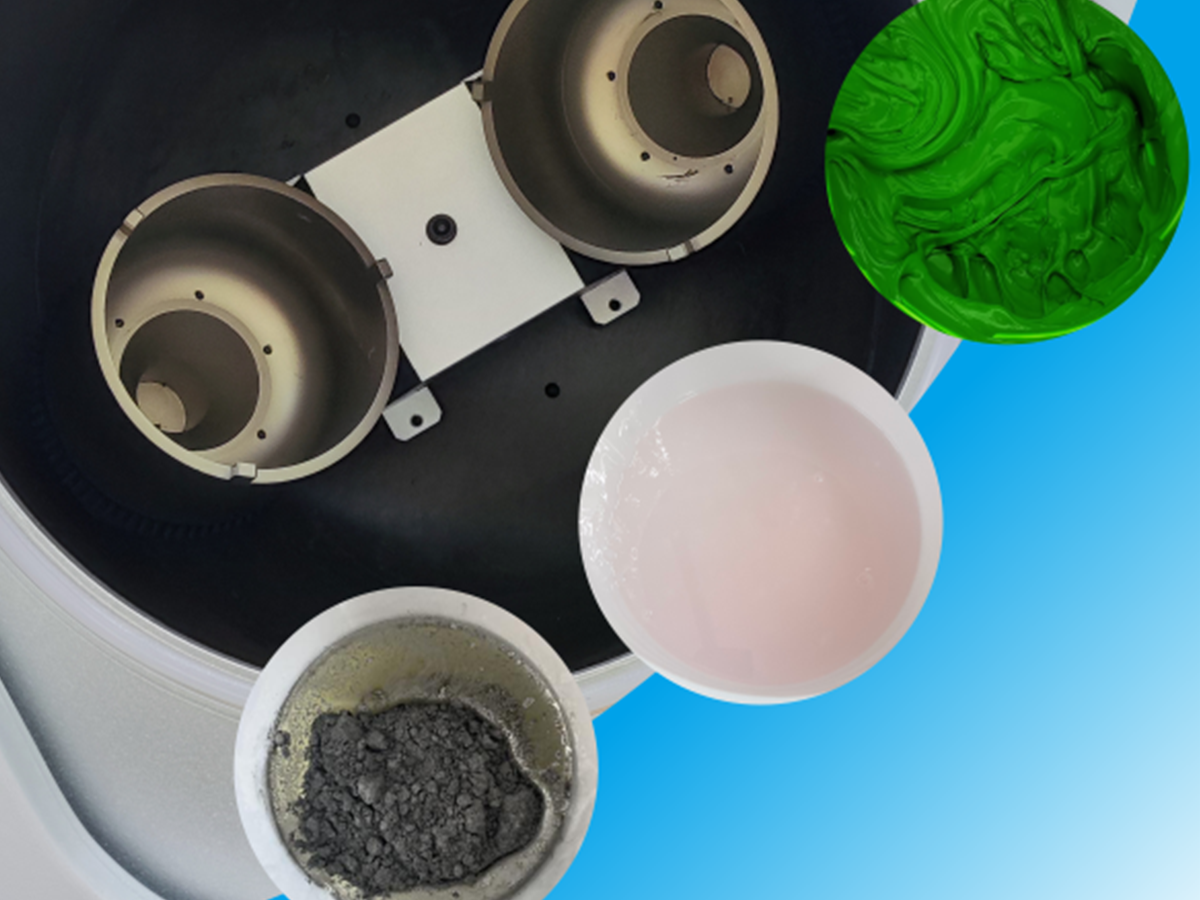
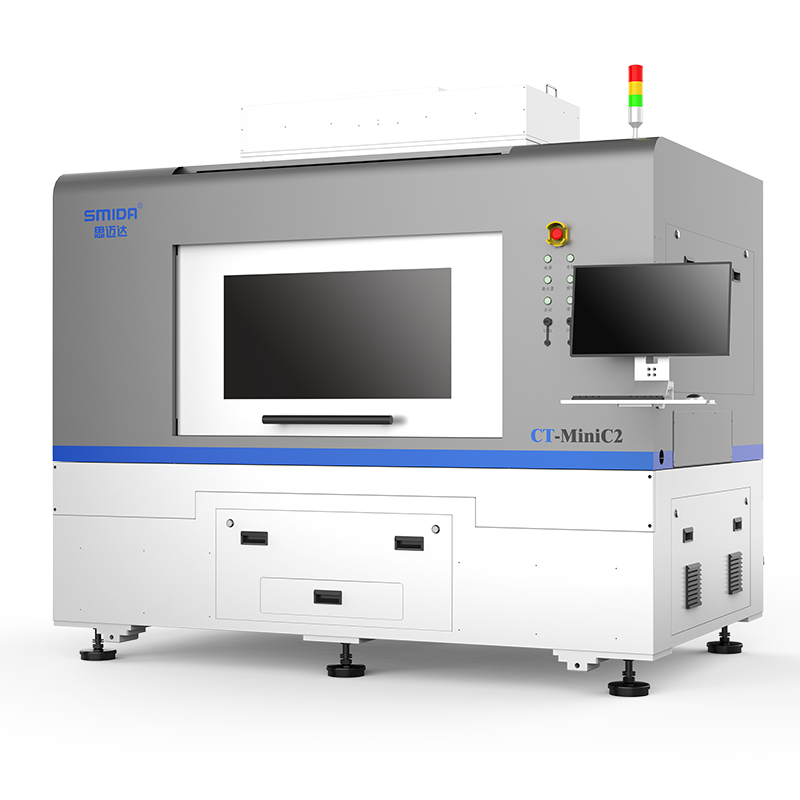
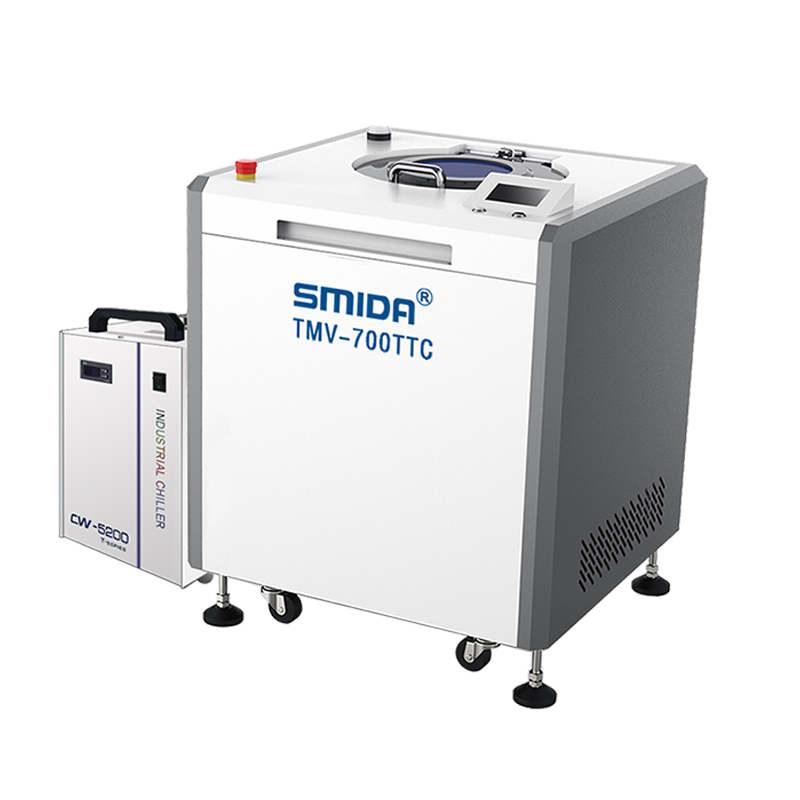
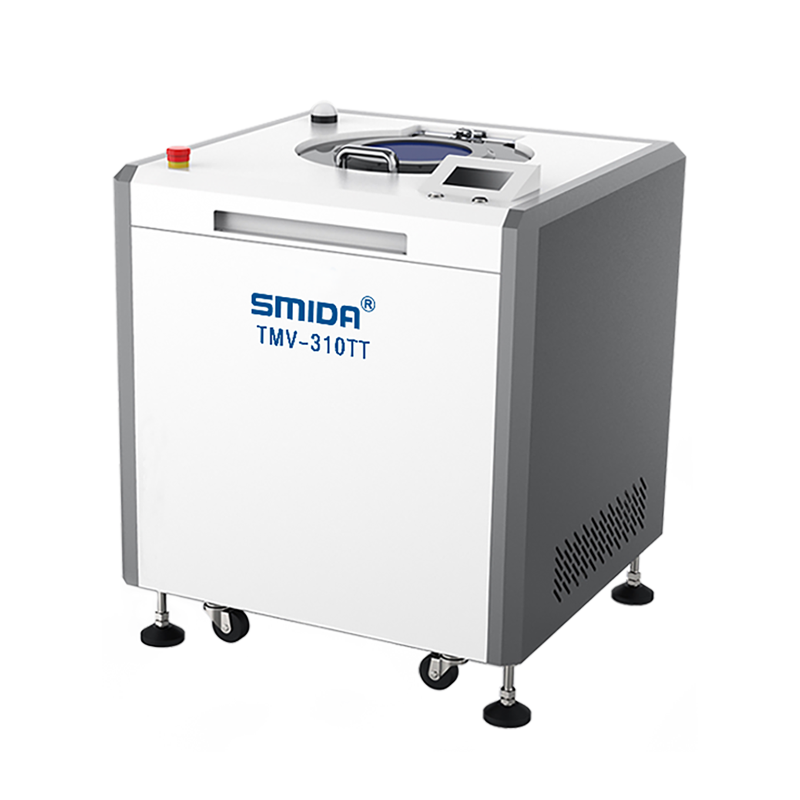
A blade-free cream mixing and degassing machine is a planetary centrifugal mixer that disperses powders into a cream's oil phase and removes trapped air under vacuum, without any blade touching the material.
Sealed cups spin around the machine axis while rotating on their own axis, generating a three-dimensional flow field that mixes and degasses at the same time.
The machine combines three forces in one cycle:
revolution, which presses the batch outward and squeezes bubbles toward the surface;
rotation, which creates even shear at the cup wall to break up agglomerates;
and vacuum, which pulls air out as soon as it reaches the surface.
No blades, no paddles, no dead zones — and no metal parts ever touching the cream.
Why Creams Turn Powdery, White and Rough
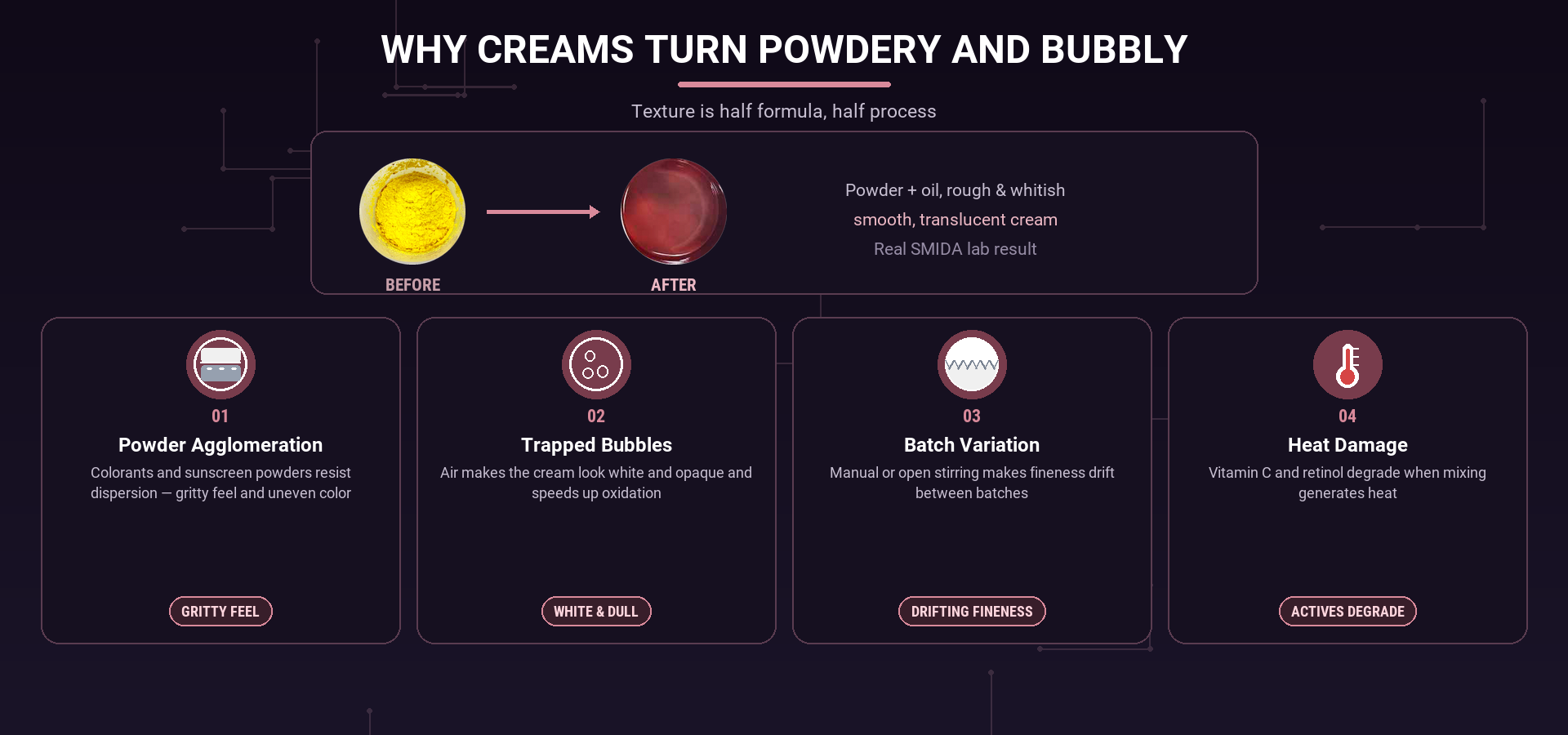
High-viscosity creams are a worst-case mixing scenario for four reasons:
-
Powder agglomeration.
Zinc oxide, titanium dioxide and color pigments have enormous surface area and a strong tendency to clump in oil.
Undispersed clumps read as a gritty, "powdery" feel and patchy color on skin. -
Air entrainment.
Fast blade mixing creates a vortex that folds air straight into the batch.
Bubbles make the cream look white and opaque, spoil the gloss, and speed up oxidation of the formula. -
Batch-to-batch drift.
Manual stirring or open-vessel mixing depends on the operator.
Fineness, viscosity and air content drift between batches even with an identical recipe. -
Heat damage.
Vitamin C, retinol and botanical actives degrade as mixing generates heat.
Loss of active potency is invisible until efficacy tests fail.
Traditional blade mixers make the problem worse in a specific way.
Shear is concentrated near the blade, leaving dead zones elsewhere;
the vortex entrains more air than it removes;
and blade wear can shed fine metal debris into a product meant for skin.
The Process: Four Steps to a Silky Cream
-
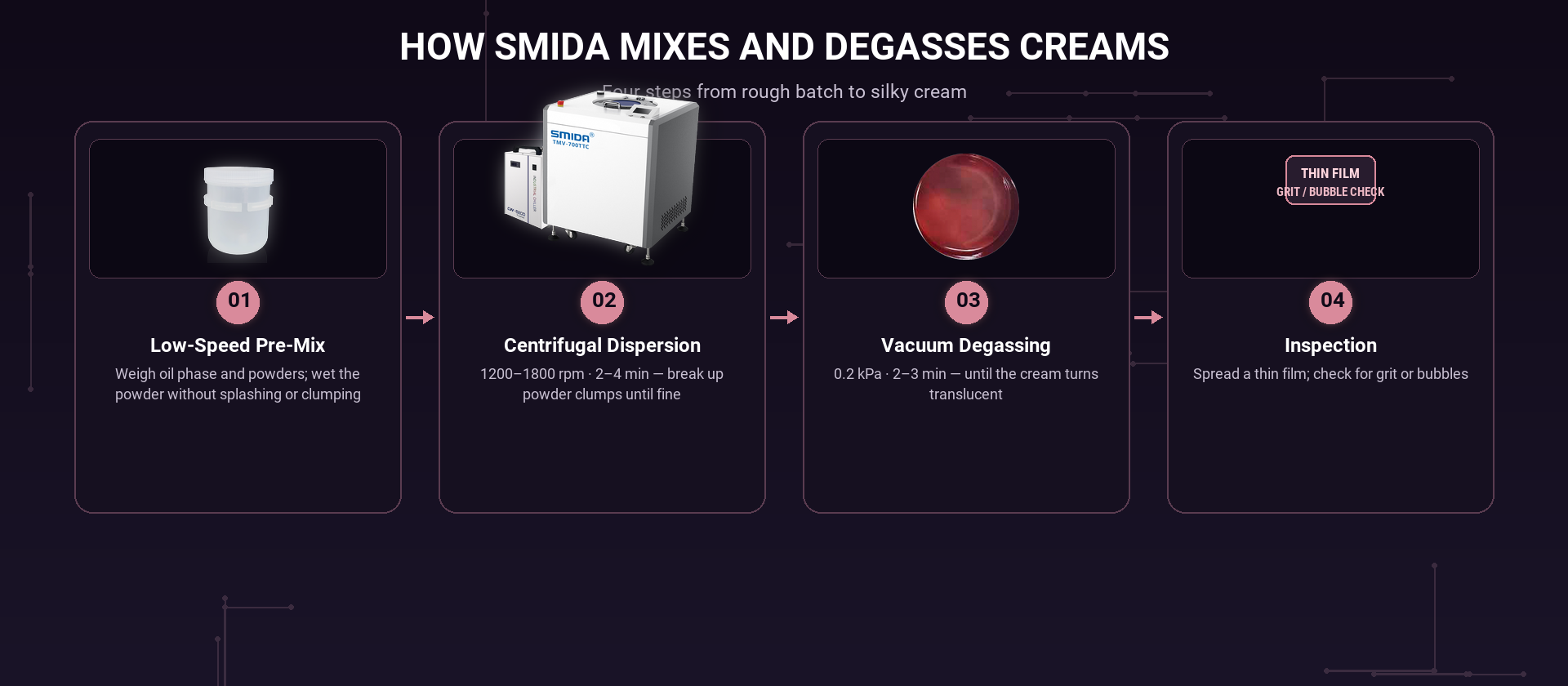
Low-speed pre-mix and wetting.
Weigh the oil phase and powders to the formula, then pre-mix at low speed so the powder wets out without splashing or clumping.
Proper wetting shortens the whole dispersion cycle. -
Centrifugal dispersion.
Run the planetary mix at 1200-1800 rpm for 2-4 minutes.
Centrifugal shear breaks the agglomerates apart, and the cream gradually turns fine and uniform. -
Vacuum degassing.
Draw the chamber down to 0.2 kPa and continue for 2-3 minutes.
The cream becomes translucent and free of microbubbles, which is exactly the look consumers read as "premium". -
Inspection before filling.
Spread a thin film on a glass plate and check for grit or bubbles.
Only bubble-free, particle-free batches move to filling.
Why SMIDA for Cream R&D and Production
-
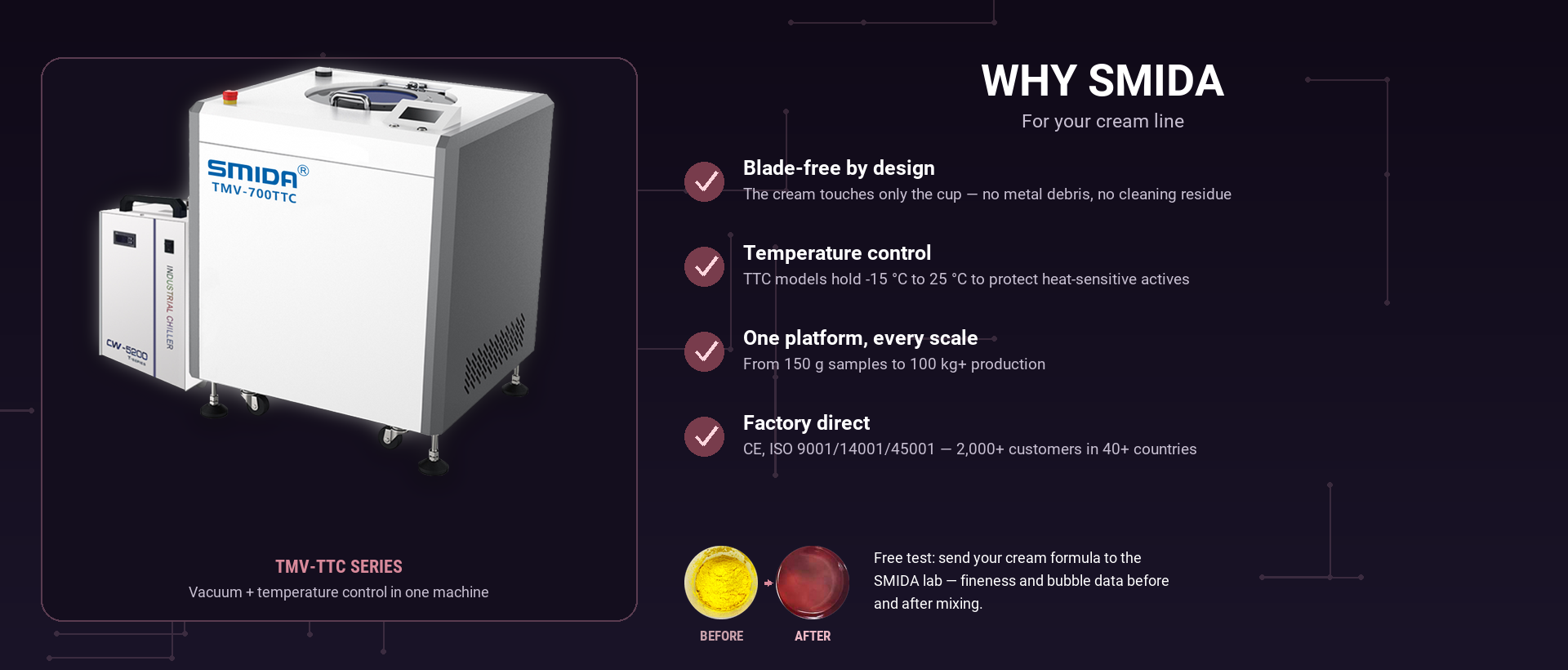
Blade-free and contact-free.
The cream touches only the sealed cup.
There is no blade wear debris, no cross-contamination between batches, and cleaning is a quick wipe of the cup. -
Temperature control for actives.
TTC models keep the batch at -15 °C to 25 °C, so vitamin C, retinol and other sensitive actives survive the process. -
Dual-cup design.
Two formulas run side by side in one cycle — ideal for comparing samples and accelerating formula iteration. -
From lab to production without rework.
One platform covers 150 g lab samples to 100 kg+ production machines, with mixing volumes from 1 g to 100 kg+.
The same parameters transfer between capacities, so scale-up no longer means starting over. -
Factory direct.
SMIDA is a Shenzhen manufacturer with 17+ years in material processing, CE, ISO 9001, ISO 14001 and ISO 45001 certified, trusted by 2,000+ customers in 40+ countries.
Frequently Asked Questions
How long does the whole cream process take?
Most cream formulations are dispersed and degassed in 4-7 minutes total: 2-4 minutes of centrifugal mixing plus 2-3 minutes of vacuum degassing.
Will centrifugal mixing damage shear-sensitive ingredients?
No blade touches the material, so shear is gentle and evenly distributed across the batch.
Fragile fillers, emollients and active particles keep their structure.
Does the machine need a vacuum to make cream smooth?
Smoothness comes from dispersion; transparency comes from degassing.
For translucent, glossy creams, the vacuum step at 0.2 kPa is what removes the whitish haze.
Can we validate the result before buying?
Yes.
SMIDA accepts samples and runs a free mixing and degassing test, reporting before-and-after fineness, bubble level and temperature data.
The Bottom Line
A cream's "premium feel" is half formula and half process.
The fastest way to upgrade texture is not a new ingredient — it is a mixing process that disperses every pigment and removes every bubble.
Send a sample to the SMIDA lab, and see your own cream before and after a blade-free vacuum mixing cycle.

 Hot News