EN
EN

Solder Paste Mixing and Degassing: The Complete SMT Process Guide for Void-Free Reflow
Most SMT lines manage storage and warm-up, then stir the paste by hand. The lines that win on yield treat mixing and degassing as a controlled process step.
Solder paste mixing and degassing: how a planetary centrifugal mixer re-suspends solder powder, removes entrapped air and prevents voids before stencil printing.
Solder paste mixing and degassing is the process of re-suspending settled solder powder and removing entrapped air before stencil printing.
Solder paste is the core auxiliary material of surface-mount assembly, and its condition decides print quality and reflow yield.
Many factories are meticulous about storage and warm-up, yet skip the mixing step entirely — or stir by hand and call it done.
That gap is exactly where skips, bridges, and voids come from.
What Happens When Solder Paste Is Not Mixed Properly
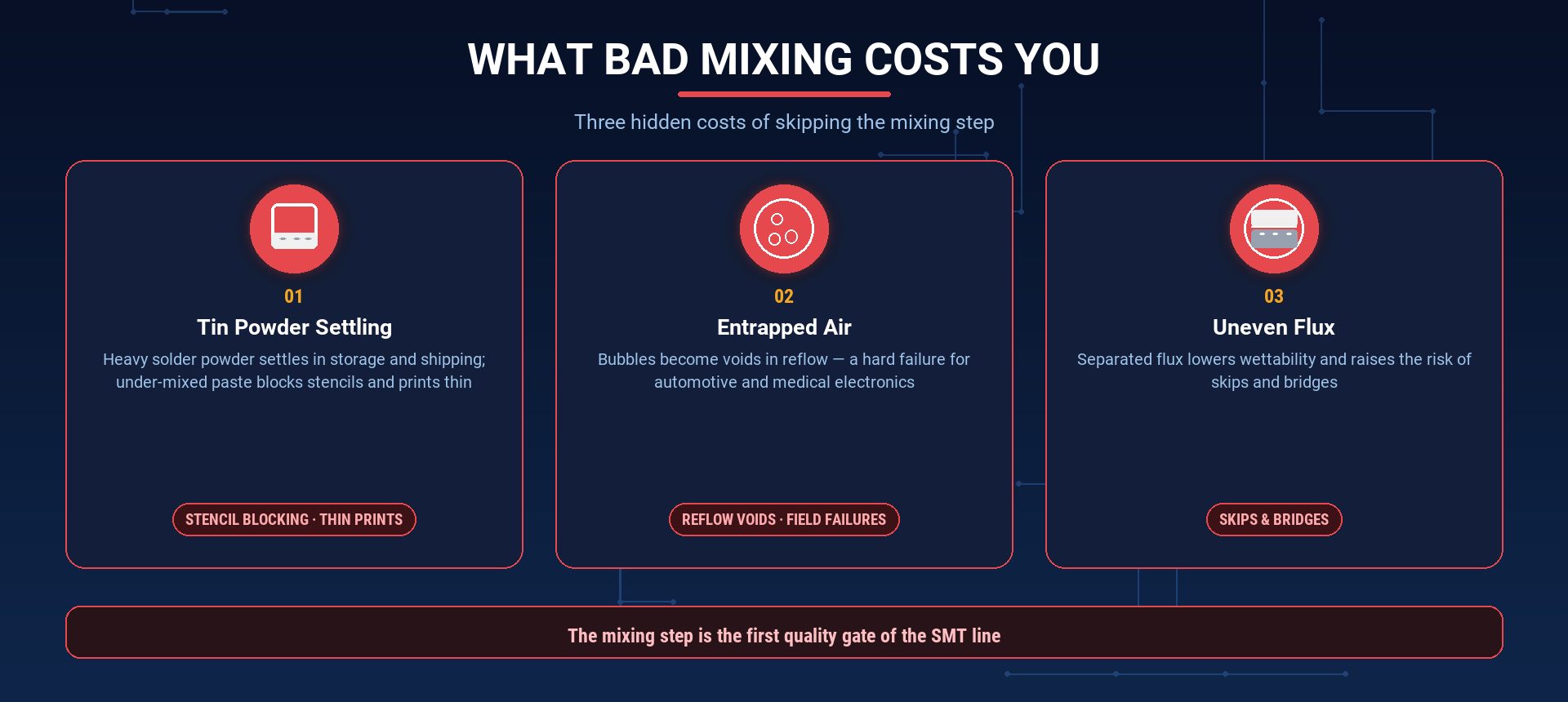
Three failure modes trace straight back to an inadequate mixing step:
-
Tin powder settling and agglomeration.
Solder powder is dense, so it settles and clumps during storage and shipping.
If the paste is printed without proper re-suspension, the stencil blocks, prints come out thin, and solder joints end up starved. -
Entrapped air.
Air folded into the paste becomes voids during reflow.
Voids weaken joint strength and reliability — a hard failure for automotive electronics, medical electronics, and other high-reliability products where void percentage is written into the specification. -
Uneven flux distribution.
When flux separates from the solder powder, wettability drops.
You get more skip-soldering, more bridging, and more rework on the line.
None of these show up in a quick visual check of the jar.
They show up later — in the AOI report, in the X-ray void count, and in field failures.
The Recommended Solder Paste Handling Workflow
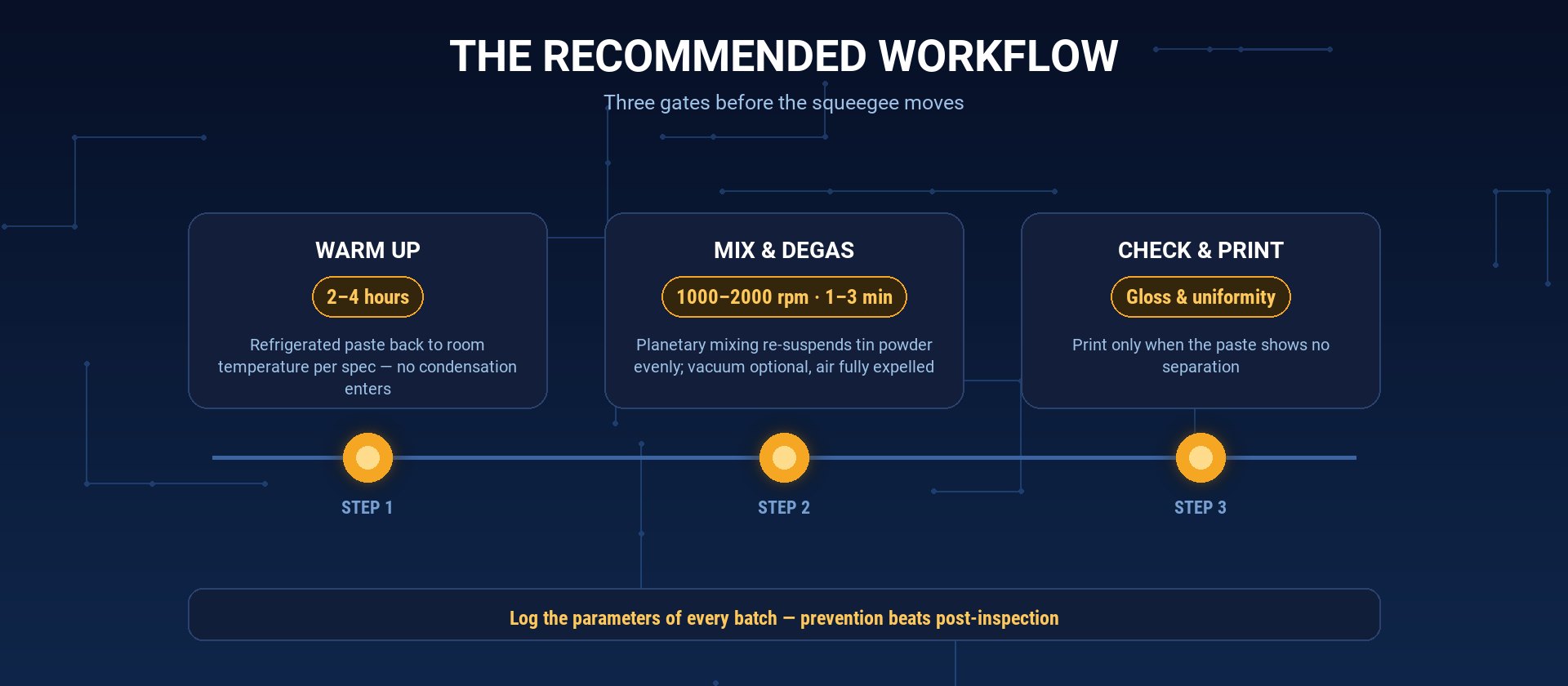
A repeatable process has three steps:
-
Warm-up.
Bring refrigerated paste to room temperature according to the manufacturer's specification — typically 2 to 4 hours — so no condensation enters the paste. -
Mixing and degassing.
Run the paste on a planetary centrifugal mixer.
As a starting reference: 1000 to 2000 rpm for 1 to 3 minutes, with vacuum optional.
The solder powder re-suspends evenly and entrapped air is expelled in the same cycle. -
Inspection.
Check the gloss and uniformity of the paste.
Only load the printer when the paste shows no separation or dulling.
Logging the parameters of every batch is what turns this workflow from a habit into a standard operating procedure.
Why Centrifugal Mixing Beats Hand Stirring for Solder Paste
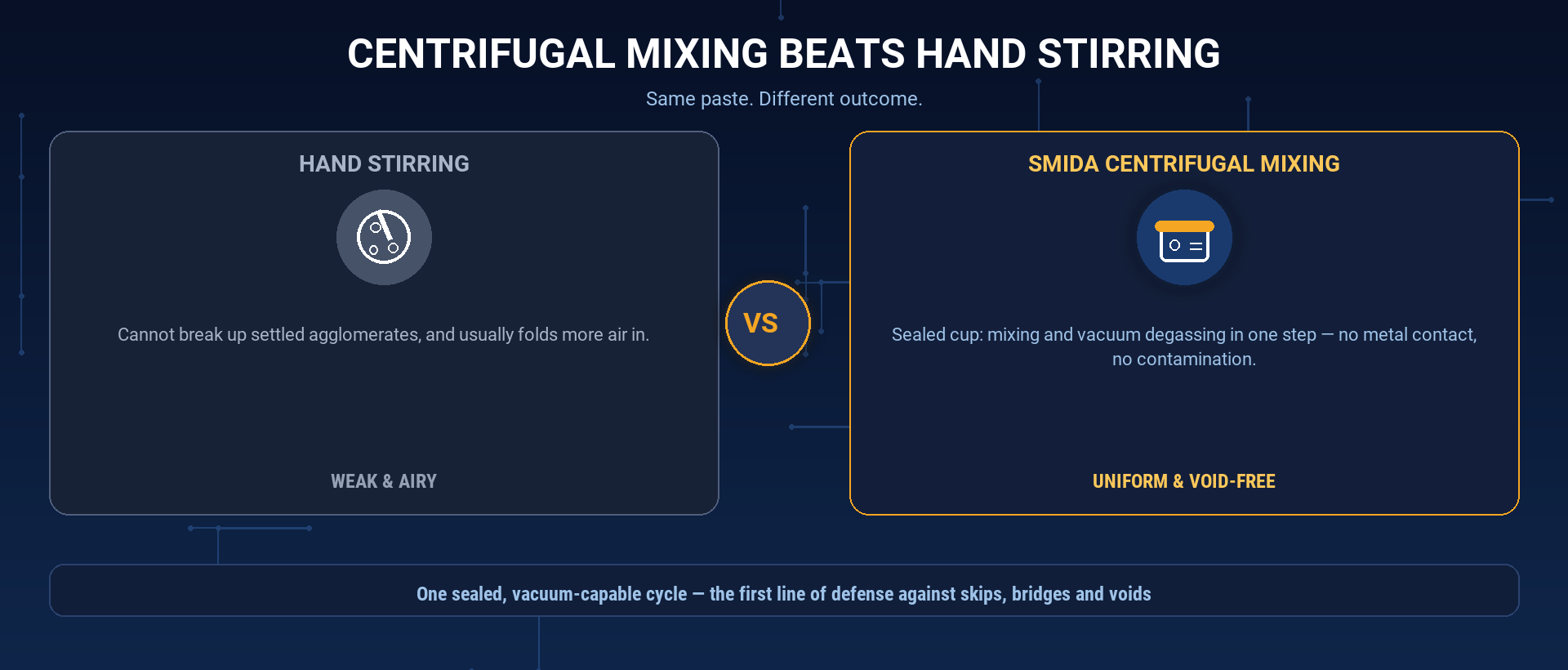
Hand stirring and simple propeller stirrers cannot break up settled solder agglomerates — the densest particles simply stay at the bottom — and stirring from the top folds air into the paste, adding the very bubbles you are trying to remove.
A planetary centrifugal mixer works differently.
The sealed cup spins on two axes at once: revolution drives the heavy solder powder back into uniform suspension with centrifugal force, while rotation shears any remaining agglomerates.
Because the cup is sealed, optional vacuum degassing removes air in the same step — no extra equipment, no exposure, no contamination.
And since no metal blades touch the paste, there is no risk of metal debris entering the material.
Why Voids Matter More Than Ever
Void percentage is no longer a nice-to-have metric.
Automotive electronics specify tight void limits because a single void under a power device can cause thermal failure, and medical devices tolerate no intermittent joints.
Because voids originate as air in the paste, removing that air before printing is the cheapest prevention available — far cheaper than X-ray inspection and rework after reflow.
How SMIDA Supports the Solder Paste Process
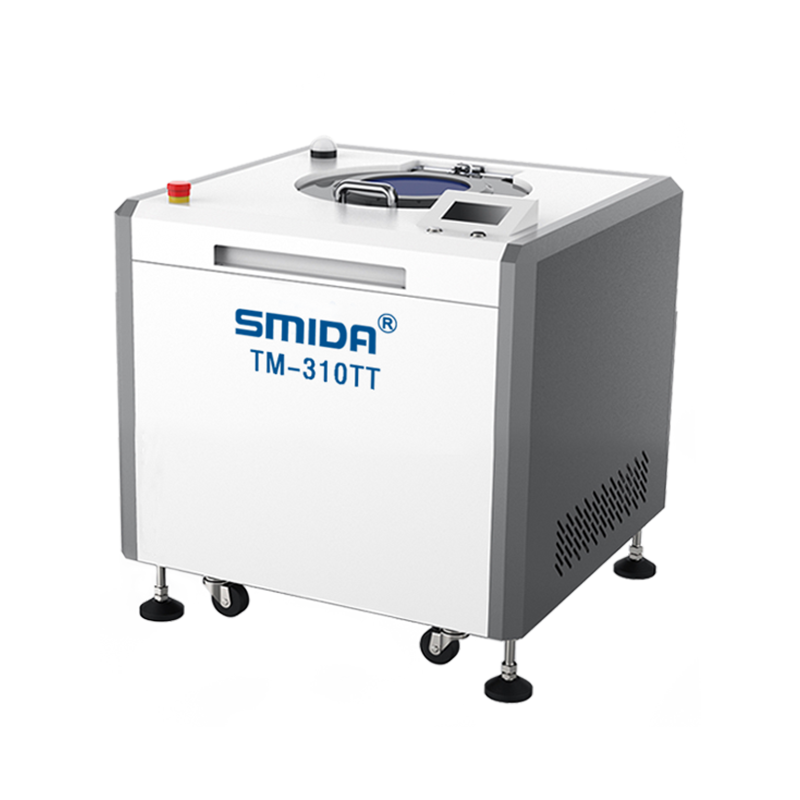
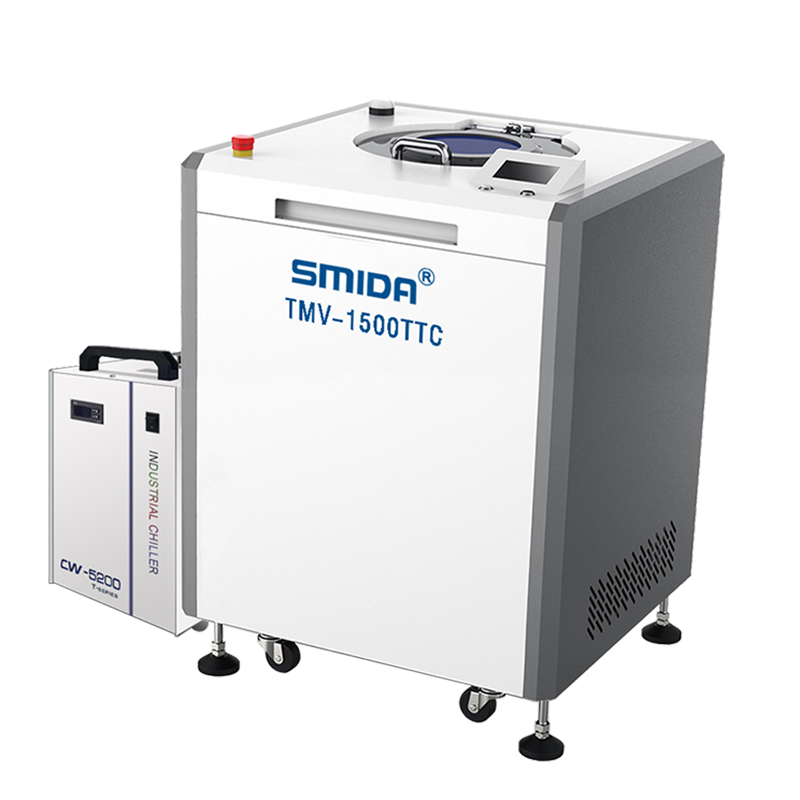
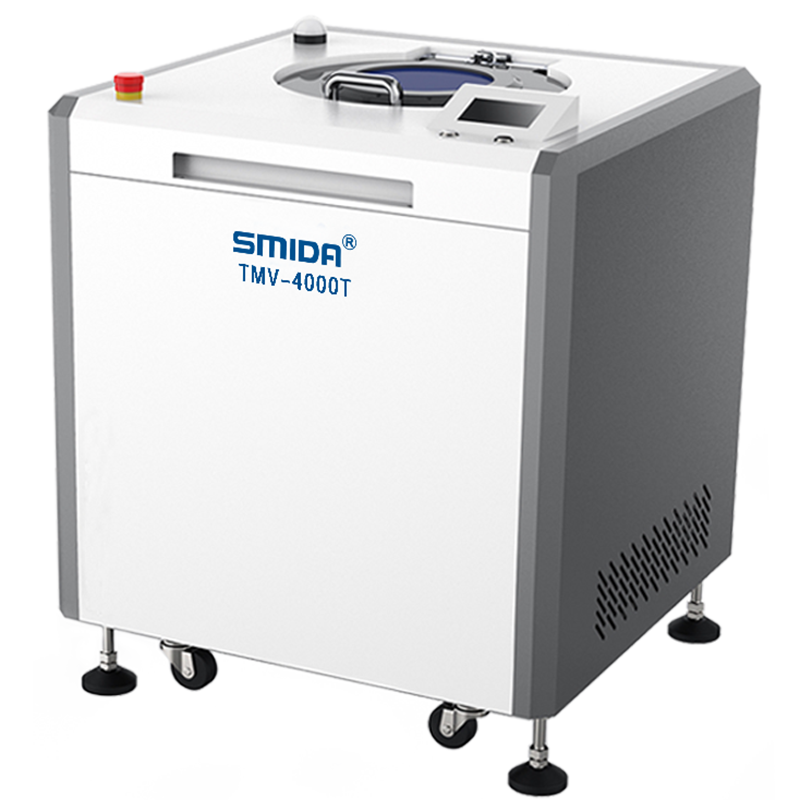
SMIDA planetary centrifugal mixers are built around the parameters that matter for solder paste:
- Speed control from 200 to 2000 rpm, with independent revolution and rotation adjustment, so you can tune the mix for fine-pitch and standard pastes alike;
- Vacuum models down to 0.2 kPa, removing microbubbles that a normal stir cannot reach;
- Temperature-controlled TTC models holding -15 °C to 25 °C, for paste families sensitive to heat build-up;
- Sealed, blade-free cups, meaning no contamination and no solvent loss;
- One platform from 150 g lab units to 100 kg+ production machines, with mixing volume from 1 g to 100 kg+.
SMIDA is a Shenzhen manufacturer with 17+ years in material processing, CE, ISO 9001, ISO 14001 and ISO 45001 certified, trusted by 2,000+ customers in 40+ countries.
Frequently Asked Questions
Do I really need to mix solder paste before printing?
Yes — once solder powder settles or air gets folded in, printing without homogenizing and degassing transfers those defects directly into the joints.
What speed and time should I use for solder paste?
A common starting point is 1000 to 2000 rpm for 1 to 3 minutes, with vacuum if voids are a known issue.
Confirm the window with your paste supplier and lock it in.
Can a planetary centrifugal mixer handle a full solder paste jar?
Yes.
SMIDA machines take sealed cups from 150 g lab samples to 100 kg+ production batches, so the same process runs at every scale.
Does mixing damage the solder powder?
No — mixing is blade-free and shear is gentle and uniform, so powder particle size and shape distribution are preserved.
The Bottom Line
Solder paste mixing and degassing is the invisible switch of SMT yield.
Flick it correctly and skips, bridges, and voids drop before you ever touch the reflow profile.
Competition in yield is often won on exactly these hidden switches.
See it on your own paste.
Send a solder paste sample to the SMIDA lab for a free mixing and degassing test.
We will run your material, return before-and-after void data, and recommend the right model — from 150 g lab units to industrial large-capacity machines — before you spend a dollar.

 Hot News